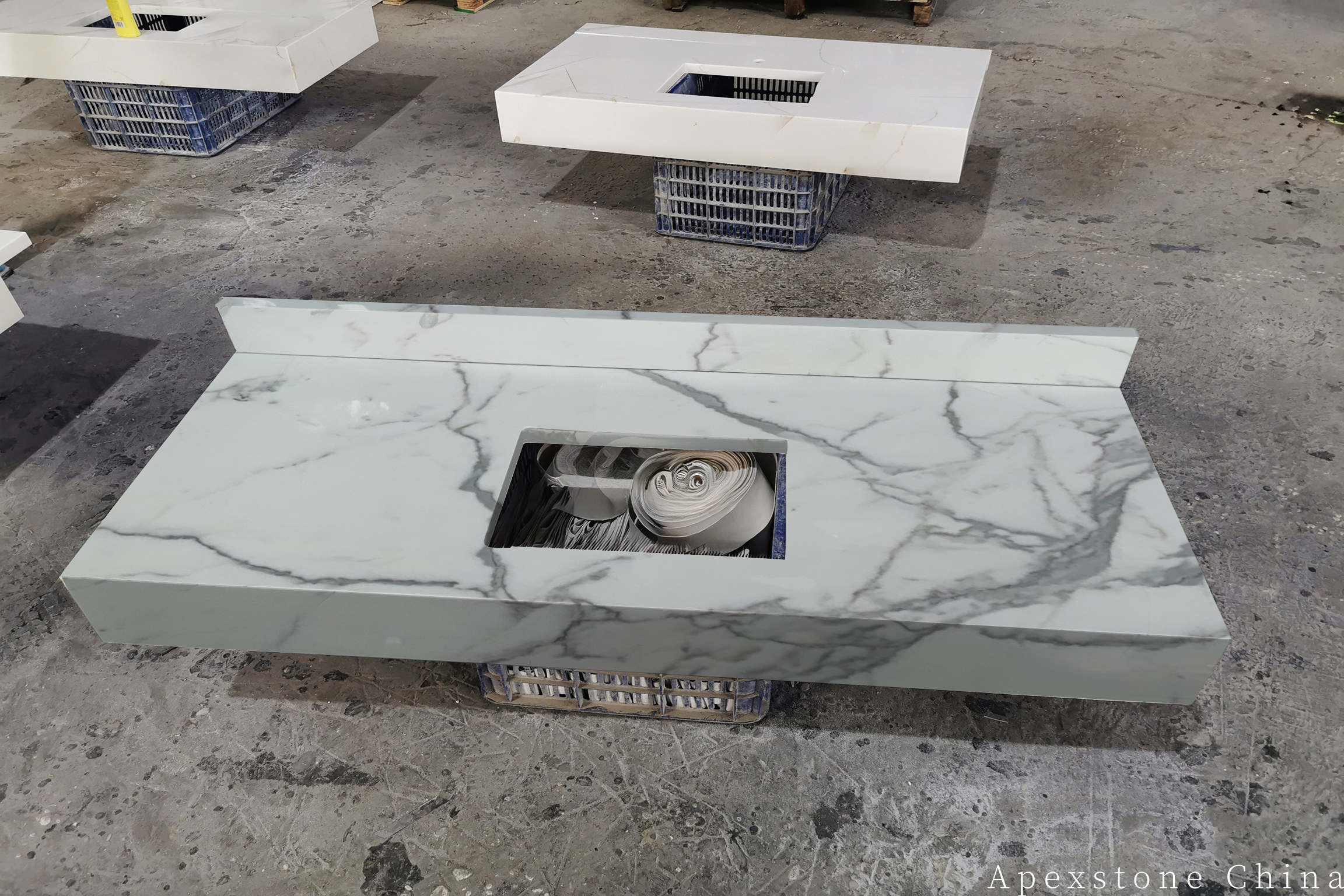
A purchasing guide for US buyers, importers and remodeling contractors sourcing stone bathroom vanity tops with sink. It covers how to match a top to cabinet size, which stone suits which project, how sink and faucet cutouts are set from templates, thickness and edge decisions, and the drawings you need before an order goes to the CNC line.
Sourcing guide
A bathroom vanity top with sink is ordered as a dimensioned assembly, not as a slab in a color. The cabinet footprint sets the top size, the cutout template set by the sink you intend to install, and the stone and finish have to survive a wet room. This guide walks through the decisions in the order they reach the factory floor: sizing against the cabinet, material choice, sink and faucet cutouts, thickness and edge, then the drawings to send before production.
If you only need a size reference chart, the companion page on marble vanity top sizes covers nominal widths and double-sink options. Here the focus is the selection decision and how cutouts move from a template to a finished top.
On this page
Start from the cabinet, not the slab
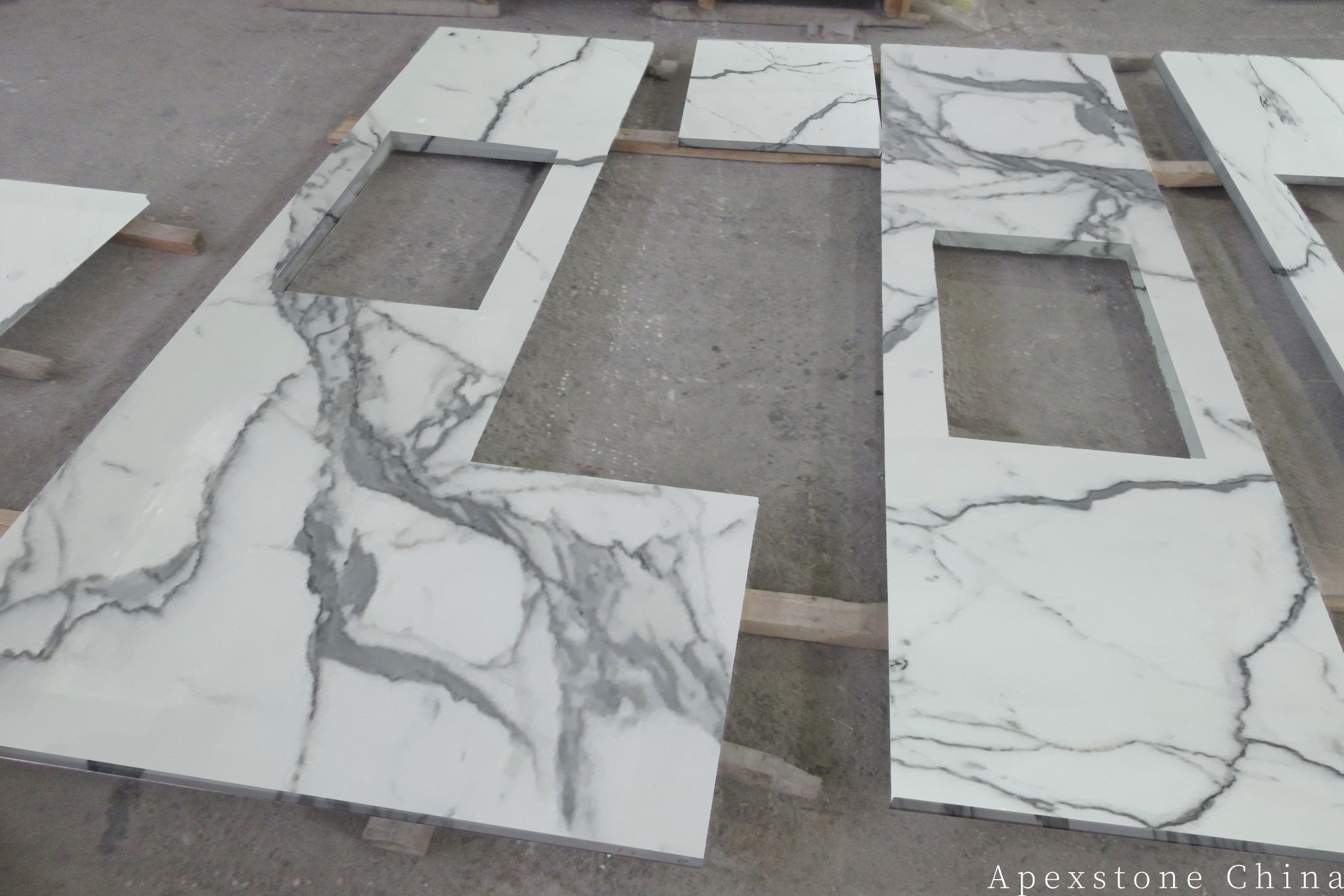
The top is cut to the cabinet run it sits on. Measure the cabinet body at the outside faces, then decide how much overhang you want on the exposed sides and front. On a standard single vanity, the top width follows the cabinet width, and the depth is set by the cabinet depth plus overhang. On a double vanity the same logic applies across a longer run.
The products we quote are specified by nominal width. The Calacatta White single top is offered at 25.5, 31, 36 and 37 in, and the double at 60 and 72 in. Pandora is offered at 25.5, 36, 37, 60 and 72 in with a 22 in depth. Travertine Romano runs 24–71 in wide and 20–24 in deep. Those are the widths the factory works to; the number you hand over should be the cabinet dimension plus overhang, checked against the nearest nominal size the program offers.
Three practical points come up repeatedly with US contractors:
- Wall-to-wall alcoves leave no room for error. Measure at the front, middle and back of the cabinet, and send the smallest figure, because the top cannot be longer than the narrowest point.
- Furniture-style vanities with an open or painted side usually want a small side overhang. State it in inches on the drawing rather than leaving it to assumption.
- Old tops as the measuring reference: hold the tape on the cabinet, not on the old top. Old tops are frequently out of square after removal, and reusing their dimensions carries the previous error into the new order.
Which stone suits which project
Marble, travertine and quartzite behave differently in a bathroom, and the useful question is not which is "best" but which fits the job in front of you. The trade-level comparison on vanity top materials goes deeper on that; the short version follows.
| Material | Available formats (from product data) | Where it fits |
|---|---|---|
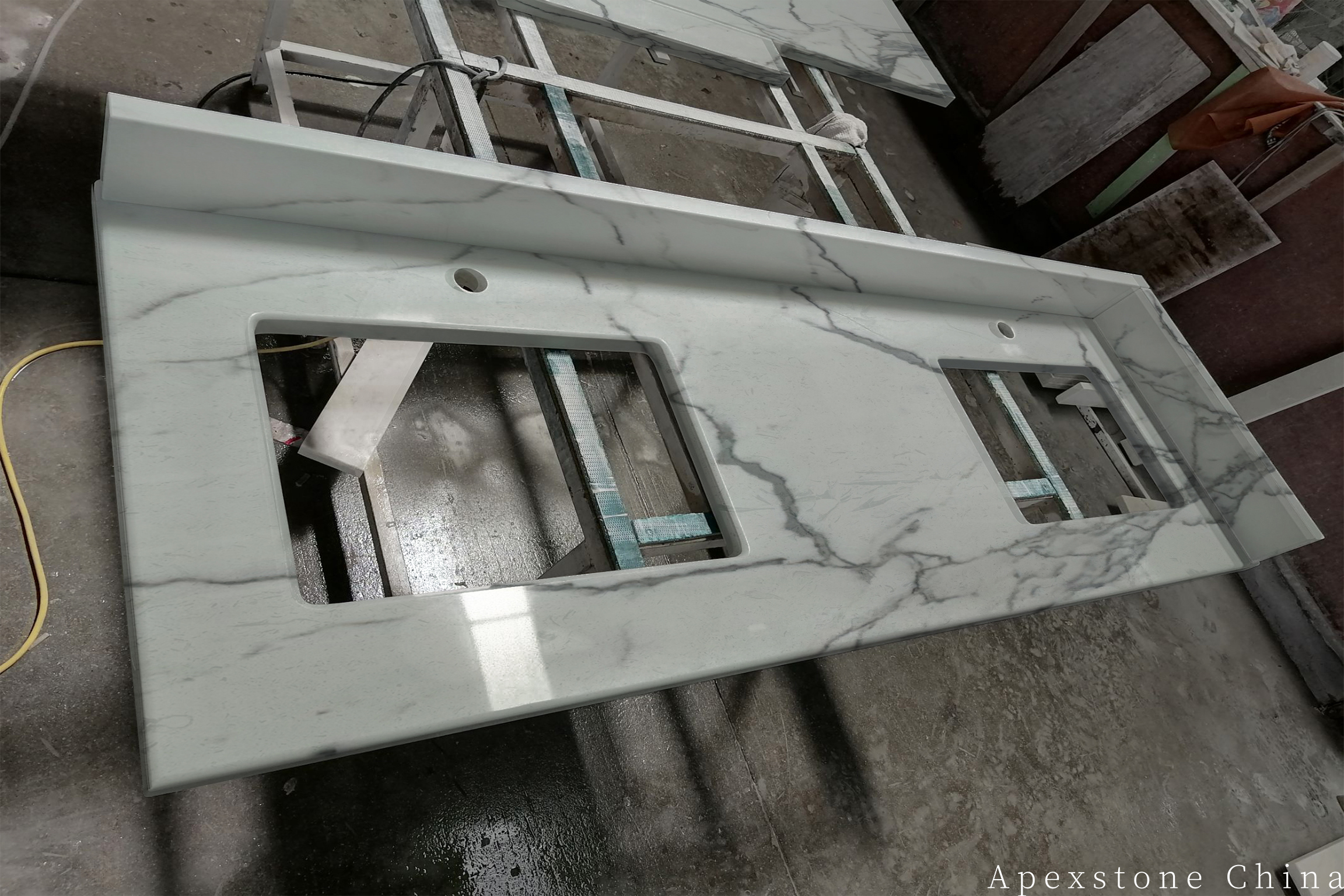
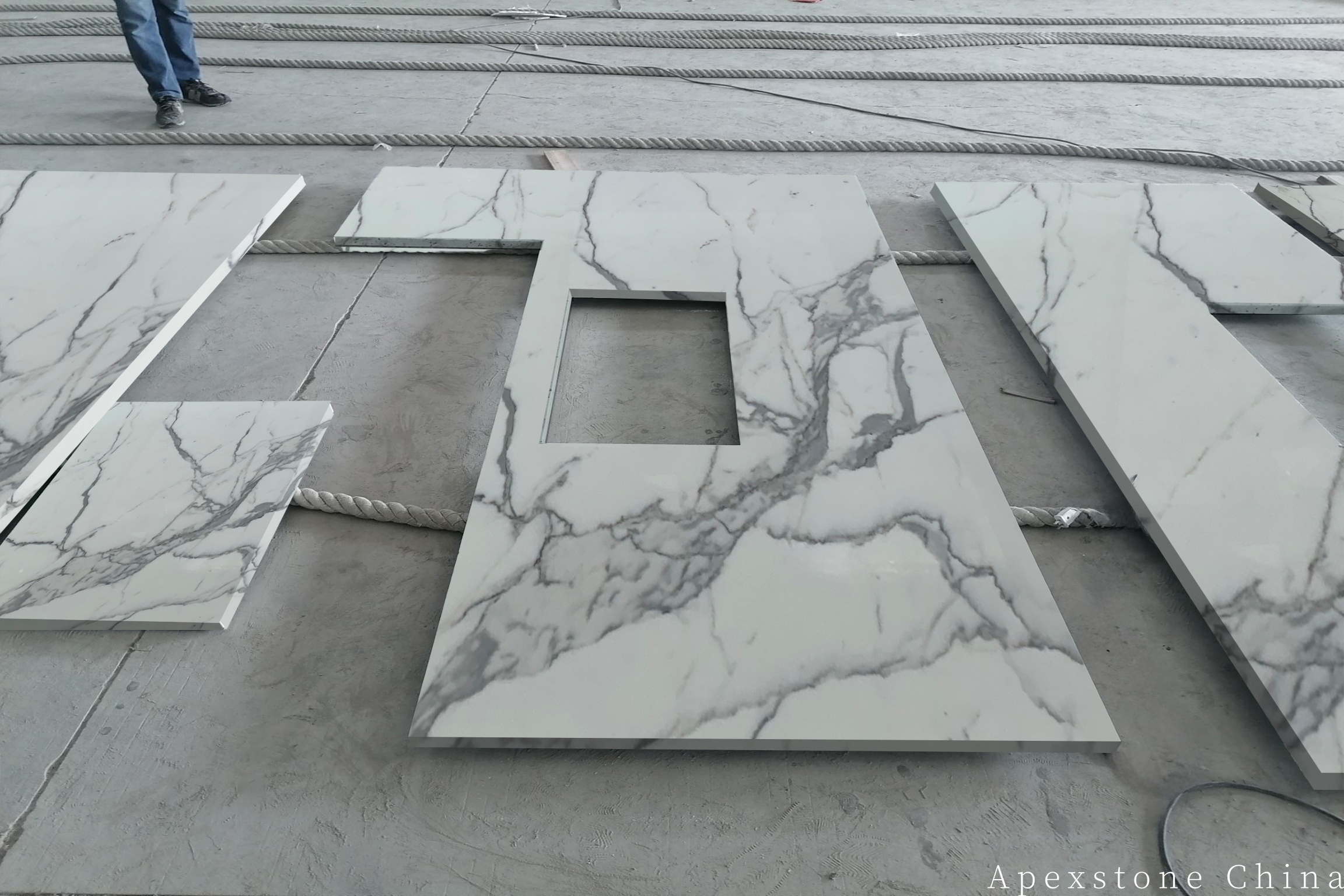
| Calacatta White marble | Single tops 25.5/31/36/37 in; double 60/72 in; 20 mm (3/4 in nominal) or 30 mm (1-1/4 in nominal); honed or polished; 4 in (≈100 mm) upstand; undermount, vessel or integrated cutouts CNC-machined to approved templates | Projects where the visual is the selling point: primary bathrooms, showroom displays, higher-end remodels where the client has chosen the stone look first |
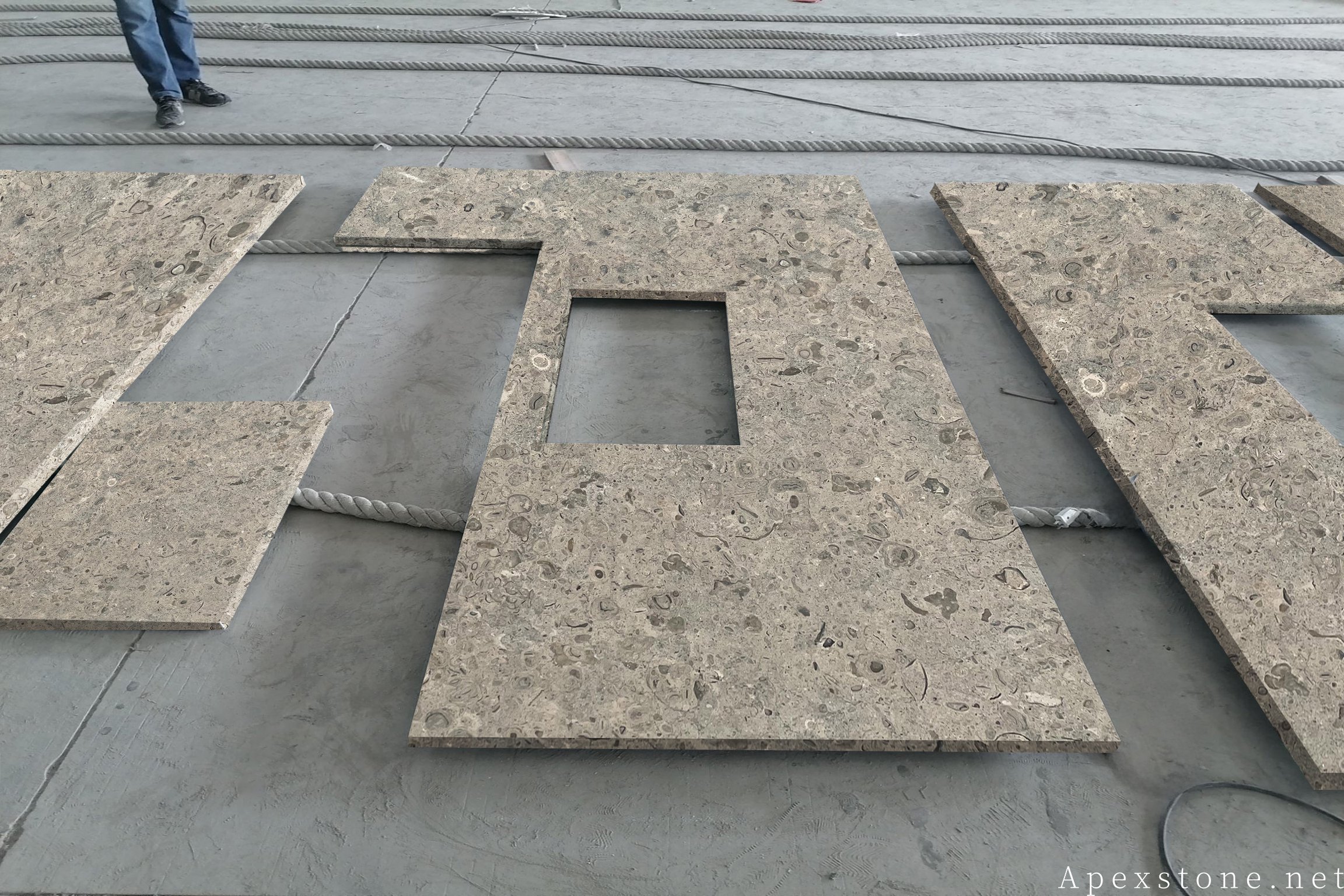
| Travertine Romano | 18/20/30 mm thickness; 24–71 in wide; 20–24 in deep; filled honed as the standard finish for wet areas | Warmer, more textured installations; filled honed suits bathroom use where an open or unhoned surface is not wanted |
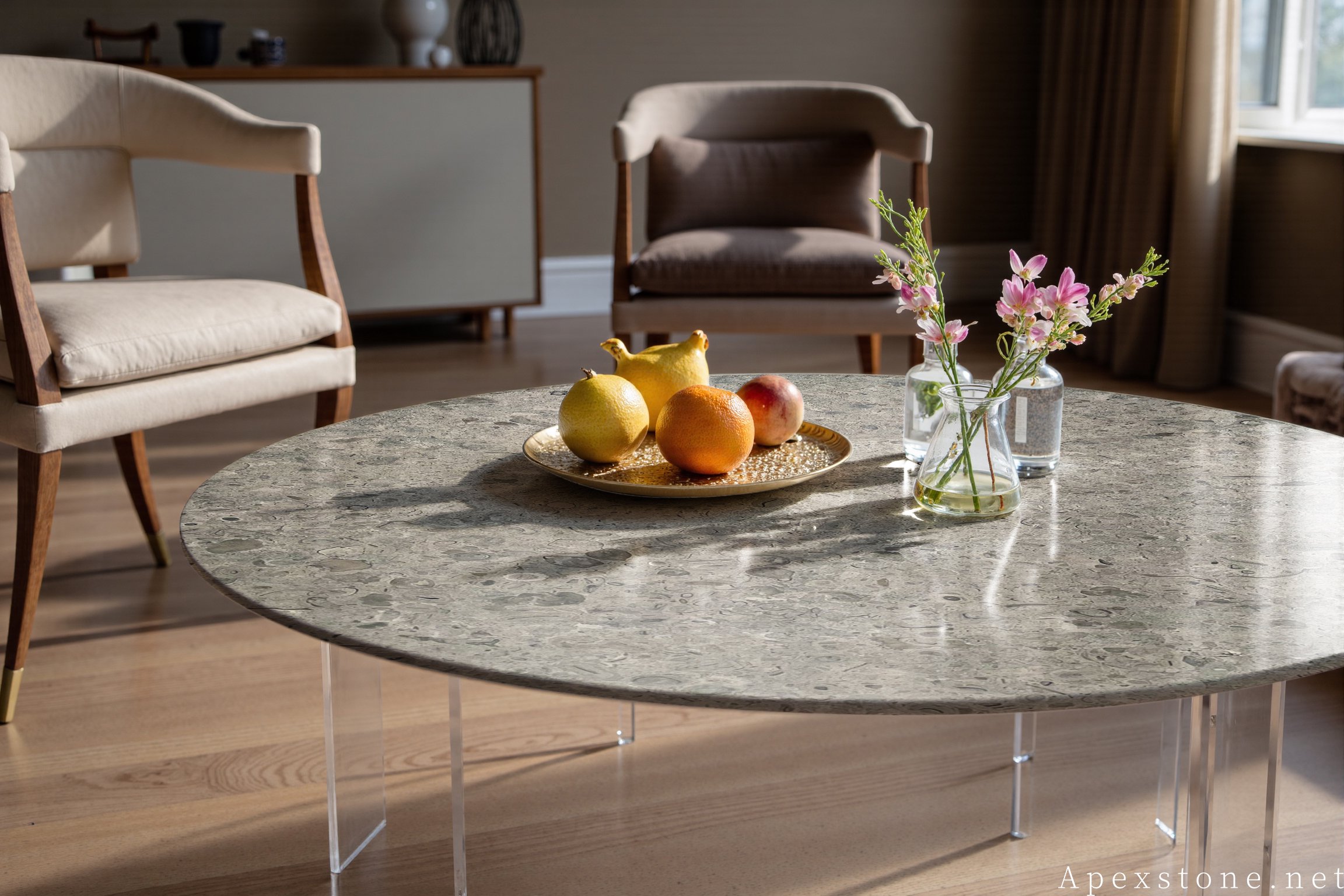
| Pandora quartzite | 25.5/36/37/60/72 in wide; 2 cm (3/4 in nominal) thick; 22 in deep; undermount rectangular or oval, or vessel, cut to the basin template | Buyers who want a quartzite look with a defined depth range and both single and double widths in the same family |
| Aqua Grey | 18/20/30 mm thickness; honed recommended for wet areas | Neutral grey schemes where a honed surface is the intended finish |
Finish is a specification, not a preference. On Travertine Romano and Aqua Grey, honed is the wet-area recommendation in our product data, and filled honed is the standard Travertine Romano finish. Calacatta White is offered in both honed and polished, so the choice belongs on the purchase order. Where the basin is undermounted, the cut edge and the underside around the rim are part of the finish conversation; say so on the drawing rather than leaving it implied. Whichever finish you settle on, the daily routine that keeps it looking right is the same one set out in how to clean marble vanity tops around cosmetics and hard water.
Sink cutouts, faucet holes and templates
Cutouts are machined on CNC against an approved template. That means the sink you intend to install, or its exact template drawing, has to be on the table before machining starts. A changed sink after cutting is a new top, not a revision.
Undermount versus vessel
Undermount is the common choice for US residential work. The cutout is sized to the basin rim so the stone bears on the sink, and the rim is typically supported from below. The template is specific to the basin model. A rectangular undermount and an oval undermount from different makers are not interchangeable, even when the nominal bowl size reads the same.
Vessel installation cuts a smaller hole, sized to the drain and to the base of the vessel, with the bowl sitting on top of the stone. The drain position and the faucet spread are the two numbers that must line up. On a vessel top, faucet holes are often set further back than on an undermount; if you are reusing a faucet from a previous install, check the reach.
Integrated tops combine the top and basin in one piece, machined to the approved template. They suit buyers standardizing on a fixed specification across multiple jobs, because the basin position does not change from top to top.
Faucet holes
Faucet holes are part of the cutout drawing. State the number of holes, the spread (centers between holes) and the setback from the backsplash or rear edge. A single-hole faucet, a widespread and a three-hole setup with a separate spray are three different drawings, and the drill program follows the one you approve. Do not leave a faucet change to be sorted out at installation; by then the stone is cut.
Upstand and backsplash
Calacatta White tops are specified with a 4 in (≈100 mm) upstand. This is the height of the piece that sits along the wall behind the top. Upstand height interacts with the faucet setback and with existing tile: if the wall behind the vanity already has tile to a certain height, the upstand either sits over it or is left off, and that decision changes the rear edge of the top. Settle it on the drawing.
Layout is where a multi-piece order is decided. When a job needs a 60 in double top plus a separate 37 in single, cutting them from adjacent slab sections keeps the veining consistent. That has to be planned before the saw, not corrected afterwards, so send the full order together.
Thickness, upstand and edge
Thickness is part of the structural and visual decision, and the available range differs by product. Calacatta White is offered at 20 mm (3/4 in nominal) or 30 mm (1-1/4 in nominal). Pandora is 2 cm (3/4 in nominal). Travertine Romano and Aqua Grey are offered at 18, 20 or 30 mm.
A 20 mm top with an applied edge builds the visual thickness at the front only; a 30 mm top is solid through the edge. Which one you want has less to do with style and more to do with how the vanity is built: an apron-front cabinet, a furniture-style vanity with exposed edges, and a floating cabinet each put the front edge in different views.
Edge profile is set per order. What matters for the export order is that the profile is drawn and agreed, because a hand sketch described in words as "eased" or "bullnose" can be interpreted several ways. A simple line drawing of the section, with dimensions, removes the ambiguity. If the top will meet a side wall on one end, that end is left square and unpolished unless the drawing says otherwise.
What to prepare before you order
Almost every mismatch we see at the factory traces back to a missing drawing or a late sink change. A complete inquiry for a bathroom vanity top with sink includes:
- Cabinet dimensions: outside width, depth and height, plus the overhang wanted at exposed sides and front.
- Top size: the nominal size you are ordering from the program, and confirmation that it matches the cabinet figure.
- Material and finish: product name, thickness, honed or polished, and the finish on cut edges.
- Sink details: undermount, vessel or integrated, plus the basin make and model or the template drawing. For vessel, the base diameter and drain position.
- Faucet drilling: number of holes, spread and setback.
- Upstand: height and whether it is included, plus what happens at any side wall.
- Edge drawing: a section drawing of the profile, not a word.
- Quantity and packing: piece count and whether pieces for the same job must come from adjacent slab sections.
If any of these is open, tell us before approving rather than after. The basin template is the one item that most often arrives late, and it holds the whole cut schedule. Once the cabinet numbers, the stone and the template are confirmed together, the drawing can be issued for approval and the tops released to the CNC line.
Samples and ordering terms
The commercial terms that apply to this programme are short and worth settling early in the conversation:
- Samples: sample pieces are supplied at USD 200 per piece. For volume orders, custom sampling and prototyping against your approved drawing is free of charge.
- Third-party reports: independent inspection and test reports are available on request.
- Minimum order and lead time: orders start from 10 m2, with a lead time of 25–35 days.
Buyer questions
Can I change the sink after the top is cut?
No. Cutouts are machined to the approved template, so a different basin means a different cutout. Choose the basin before the top is released to machining.
What is the difference between an undermount and a vessel cutout on the same stone?
Undermount cutouts are sized to the basin rim so the stone edge is visible around the bowl. Vessel cutouts are smaller and sized to the drain and the base of the vessel. Faucet setback and spread also differ, so the two are separate drawings.
Is honed or polished better for a bathroom top?
It depends on the product. Calacatta White is offered in both, and the choice goes on the order. For Travertine Romano, filled honed is the standard finish for wet areas, and Aqua Grey is recommended honed for wet areas.
Can I combine a double top and a single top in one order and keep the veining consistent?
Yes, provided the pieces are planned together on the slab layout. Send the full order in one inquiry so the layout can be arranged before cutting.
Next step
Send the cabinet dimensions, the stone and finish you want, and the basin template or model, and we will confirm the available size and thickness and issue a drawing for your approval. Sink fit is the most common source of rework, so if the basin is not yet chosen, the guide to white marble vanity stone and basin fit is a useful place to narrow the options before the top is specified.