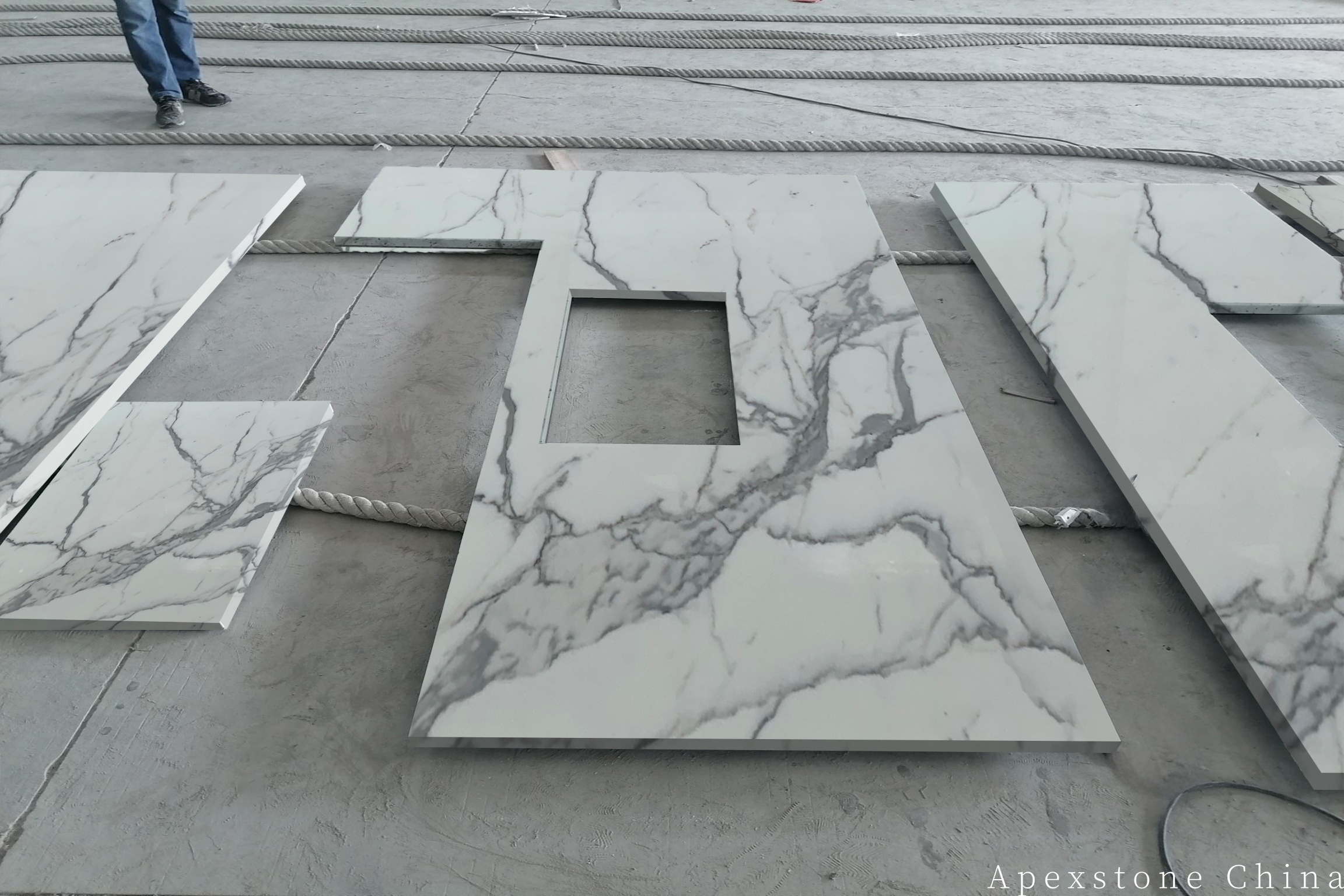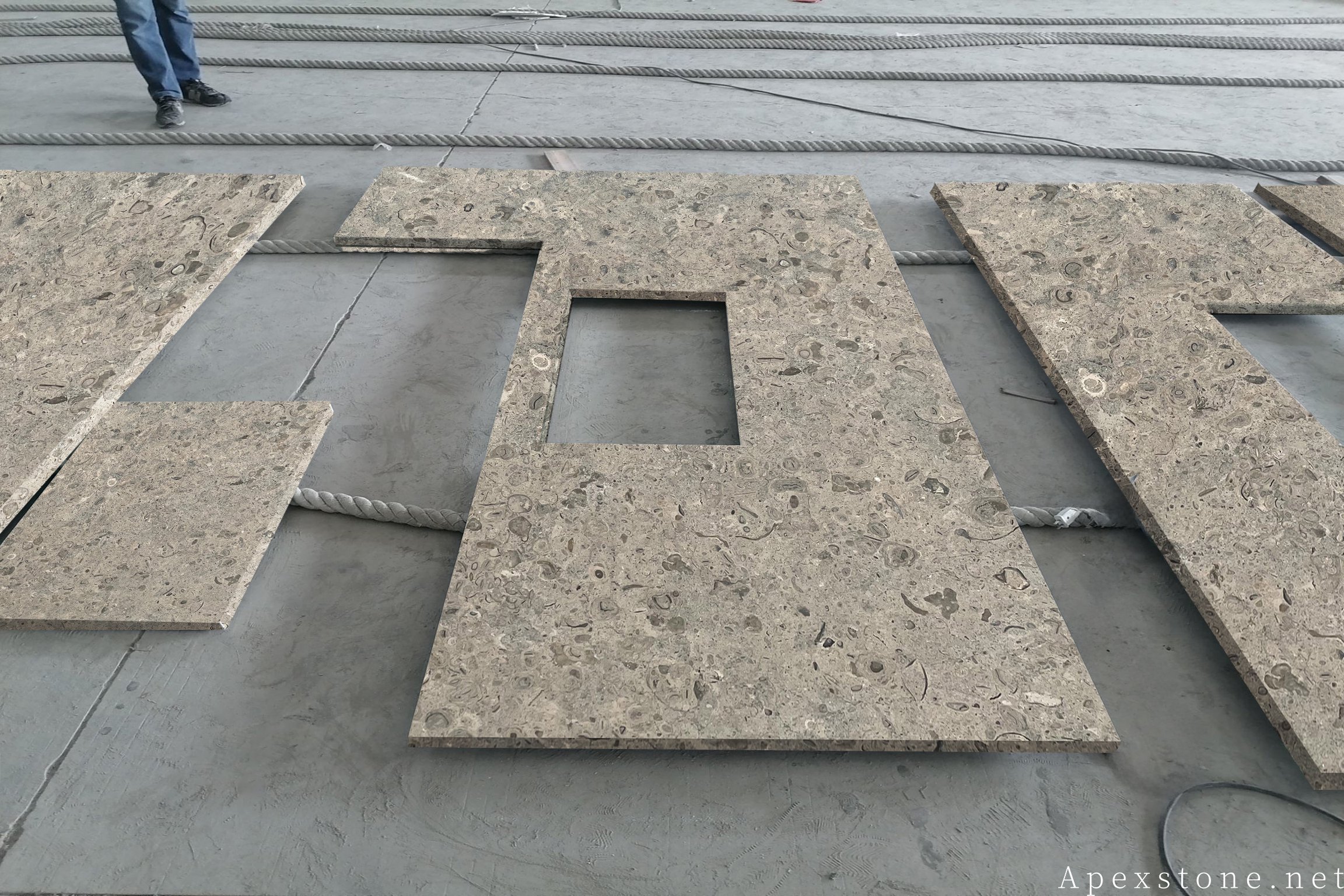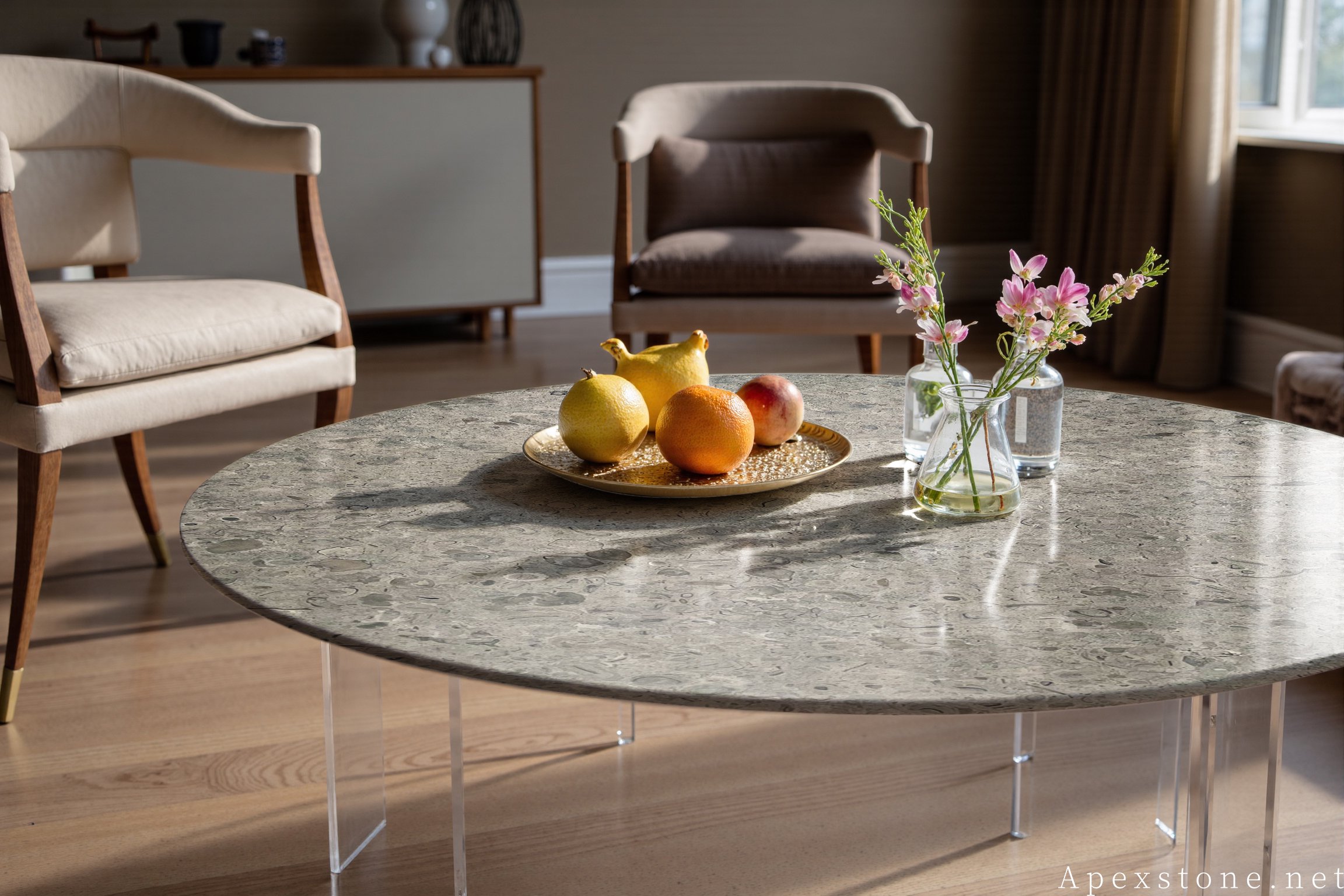
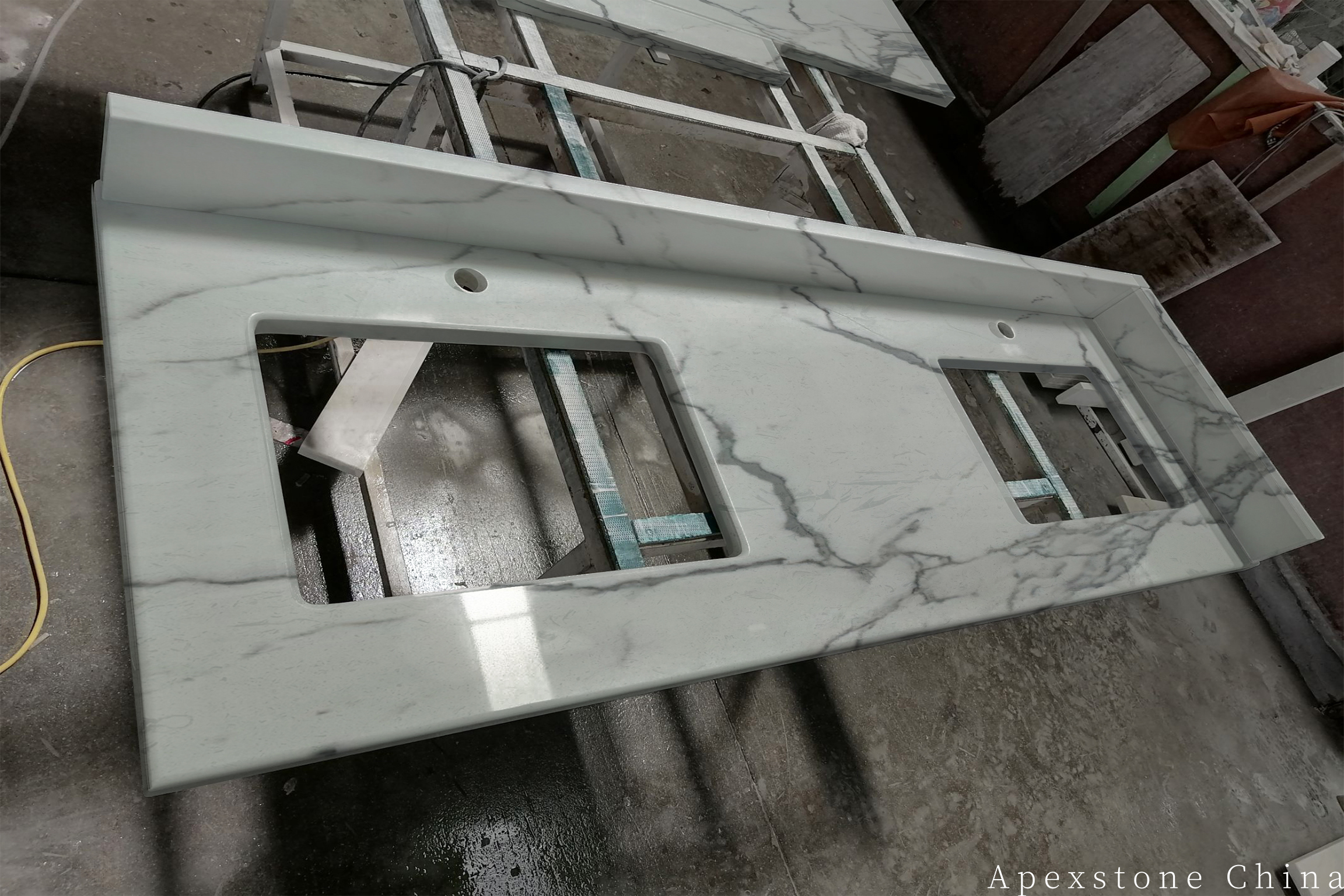
A buyer's guide to how common marble vanity top sizes map to cabinet widths and depth, when a double sink top in 60 or 72 inch makes sense, what a 21-22 inch depth means for backsplash and faucet clearance, and how sink cutouts and faucet holes are machined.
Most stone vanity tops are ordered against a cabinet width the buyer already has. The confusion starts when the top's nominal size, its actual depth and its sink layout all have to line up at once. This guide walks through the common sizes — 31x19, 37x19 and 37x22 inches — and explains when a double sink top makes sense.
- What the size numbers actually measure
- Single-sink sizes and the cabinets they suit
- What depth 21–22 inches changes
- When a marble double sink vanity top makes sense
- Cutouts, faucet holes and machining
- FAQ
What the size numbers actually measure
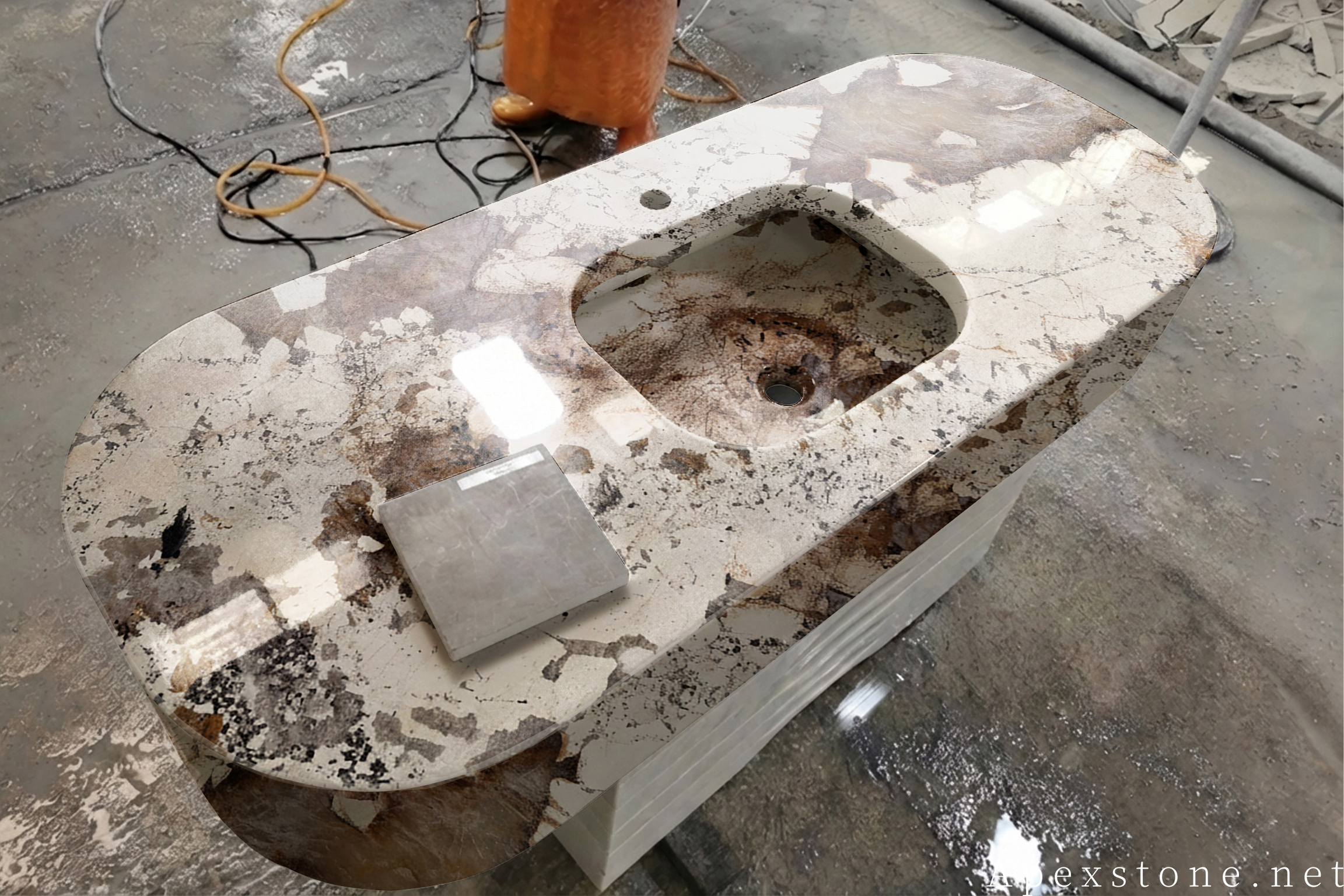
A top listed as 31x19 is being described by its width (left to right, along the cabinet front) and its depth (front to back, from the cabinet face to the wall). The first number is the one that must match the cabinet, because a marble bathroom vanity top with sink is cut to sit over the cabinet body and its edges are calibrated at the factory. The second number is where the fit against the wall, the backsplash and the faucet all get decided.
Across the natural stone tops described here, depth is generally 21–22 inches (about 533–559 mm) and thickness is most often 20mm (2cm) or 30mm (3cm), with the Romano travertine tops also available in 18mm. Those are finished dimensions, not rough slab dimensions, and they are the numbers to compare against the cabinet and the wall before ordering.
Single-sink sizes and the cabinets they suit
The single-sink widths available in Calacatta White marble are 25.5, 31, 36 and 37 inches. Pandora quartzite tops are offered in 25.5, 36 and 37 inches among their single-sink widths. In practical terms, a 31 x 19 vanity top with sink is the size most often ordered against a 30-inch cabinet, where the top overhangs the cabinet body slightly on each side. A 36 inch marble vanity top is the width to order against a 36-inch cabinet, while a 37x19 vanity top gives buyers a little more room on a nominal 36-inch base or a cabinet built to a slightly wider opening. Every one of these matches should be confirmed against the measured cabinet body width and the intended overhang before ordering, not assumed from the nominal size alone.
That one-inch difference matters more than it looks. If the cabinet run is tight between two walls, the extra inch can be the difference between a clean fit and a return. If the cabinet has room, the 37-inch top gives a bit more usable surface beside the basin.
The 49x19 vanity top size appears in buyer searches as well. It is not listed among the Calacatta White, Travertine Romano or Pandora quartzite sizes described here, so a buyer who needs 49 inches should confirm availability against the specific stone and supplier rather than assume it is a stock width.
A quick size-to-cabinet reference
| Top size | Typical cabinet it is ordered against | Notes |
|---|---|---|
| 25.5 in (about 648 mm) | Small or powder-room base | Single sink; shallow runs |
| 31 in (about 787 mm) | 30-inch cabinet | Common 31x19 size |
| 36 in (about 914 mm) | 36-inch cabinet | Single sink, wider work surface |
| 37 in (about 940 mm) | 36-inch cabinet or slightly wider base | Offered as 37x19 and 37x22 |
| 60 in (about 1524 mm) | Double vanity cabinet | Commonly double sink; confirm per stone |
| 72 in (about 1829 mm) | Double vanity cabinet | Commonly double sink; confirm per stone |
Travertine Romano tops are described in metric widths from 600–1800mm (approximately 24–71 inches), so a buyer working in millimetres can match a cabinet directly without converting from an imperial list.
What depth 21–22 inches changes
Depth is the dimension buyers underestimate. A 37x19 vanity top and a 37x22 vanity top are the same width but behave differently against the wall. With a 19-inch depth, the back edge sits closer to the wall and there is less material behind the basin; with 21–22 inches, there is more room behind the cutout for the faucet body, the supply connections and the backsplash line.
For a marble top with a backsplash, the deeper option leaves more flat stone between the basin cutout and the wall, which is where the splash sits. On a shallower top, that strip narrows, and the faucet has to be placed carefully so it does not crowd the cutout. Faucet hole positions are machined at the factory, so the depth decision and the faucet choice should be made together rather than after the top arrives. Whether the deeper top genuinely fits a given faucet and backsplash should be checked against the basin model, the faucet base size and the planned backsplash width before ordering.
Where the cabinet is shallower than the top, the difference shows up as front overhang. That is a cabinet-and-top relationship the buyer should measure on site; the top is cut to the stated depth, and the cabinet has to be checked against it.
When a marble double sink vanity top makes sense
A marble double sink vanity top is most commonly ordered in 60 or 72 inches; whether a given stone offers those widths as double-basin layouts should be confirmed with the supplier at order stage. The 60-inch top suits a two-basin cabinet in a shared bathroom where two people need to wash at the same time without stepping around each other. The 72 inch marble vanity top suits longer runs where the extra width gives each basin more counter space between them, and where the room can carry the cabinet length.
The trade-off is straightforward. A double-sink top needs a drain and supply connection on each side, so plumbing rough-in has to be planned before the cabinet is fixed. It also needs a cabinet wide enough to support the stone across the full span. On a narrow wall, a single 36 or 37-inch top with one basin is the more workable answer, with the second user served by a separate station.
For buyers comparing options across stones, the Calacatta White marble vanity tops page lists the single- and double-sink widths together, so the 31, 36, 37, 60 and 72-inch formats can be checked in one place.
Cutouts, faucet holes and machining
On Pandora quartzite vanity tops, sink and faucet cutouts are CNC-cut to the basin template. That means the cutout follows the basin the buyer specifies rather than a generic opening, and single-piece orders are possible, which matters when a project needs one top in a size that is not part of a routine batch.
Because the cutout is tied to the basin template, the basin model should be confirmed before production. An undermount basin and a drop-in basin do not use the same opening, and the faucet hole spacing has to suit the faucet being fitted. This is also where the 37x19 and 37x22 difference becomes practical: the deeper top leaves more room behind the cutout for the faucet, and the machining plan can use that space.
Edge calibration is part of the same story. Travertine Romano vanity tops are calibrated to within plus or minus 0.5 mm, which is the tolerance that lets a top and a cabinet line up without visible steps at the joint. For wet areas, a filled and honed surface is recommended for the Romano travertine, and the stone is offered in 18mm, 20mm and 30mm thicknesses.
Buyers who want to see how the Romano format and finish are specified can review the Travertine Romano vanity tops page, and the Pandora quartzite vanity tops page for the cutout-to-template process.
Before you order, confirm these four things
- The cabinet width and the cabinet depth, measured on site, not taken from a plan.
- The basin model, so the cutout can be matched to its template.
- The faucet model and hole spacing, especially on 19-inch depth tops.
- Whether a backsplash is being fitted, and how much flat stone is needed behind the cutout.
Frequently asked questions
Will a 37x19 vanity top fit a 36 inch cabinet?
The 37-inch width is offered as a single-sink size alongside the 36-inch width, so it is intended for a nominal 36-inch cabinet or a base built to a slightly wider opening. Measure the cabinet body and the wall-to-wall space, then check the stated top width against that measurement before ordering.
When should I choose a 72 inch marble vanity top over a 60 inch one?
Choose 72 inches when the run is long enough to carry it and each basin needs more counter space between them. The 60-inch double-sink top suits a standard two-basin cabinet in a shared bathroom. Both require drain and supply connections on each side, planned before the cabinet is fixed.
Does a deeper top make a difference to the faucet?
Yes. A 37x22 vanity top leaves more flat stone behind the basin cutout than a 37x19 top, which gives the faucet body and connections more room and keeps the backsplash line clear of the cutout. Faucet holes are machined at the factory, so confirm the faucet model with the cutout specification.