A specification guide for buyers ordering travertine coping tiles: what actually ships (profiled edge units, not field tiles), which thickness, profile and finish to specify, and how the coping order should be planned together with the travertine deck pavers.
Manufacturer's specification notes · Travertine Romano
A travertine pool edge is not one order made of one material. What arrives on site is two distinct product sets that must be planned together: travertine coping tiles — long, narrow units fabricated with a finished nose on one or both edges — and the travertine deck pavers that sit behind them. Get the coping right and the pool edge reads as a single clean line for its whole length. Get it wrong and you discover it at installation, when the deck is already fixed.
These notes come from our own cutting and finishing line at Apexstone, where pool coping is produced from Travertine Romano (Classico Roma, Italy). They cover what coping actually consists of, the thickness, profile and finish to put on the order, and how the coping and deck quantities should be sequenced.
Coping units vs field tiles: what the difference actually costs you
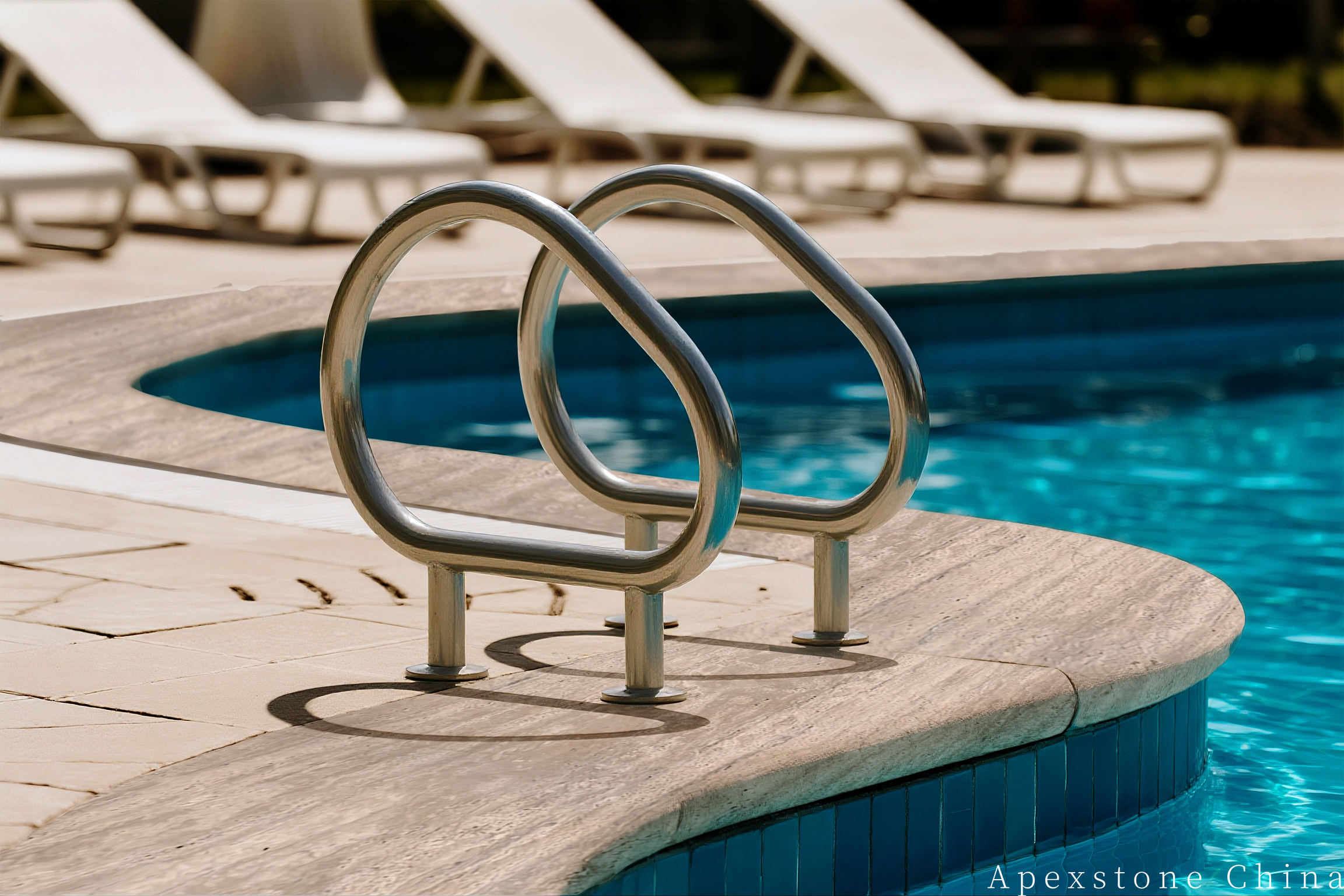
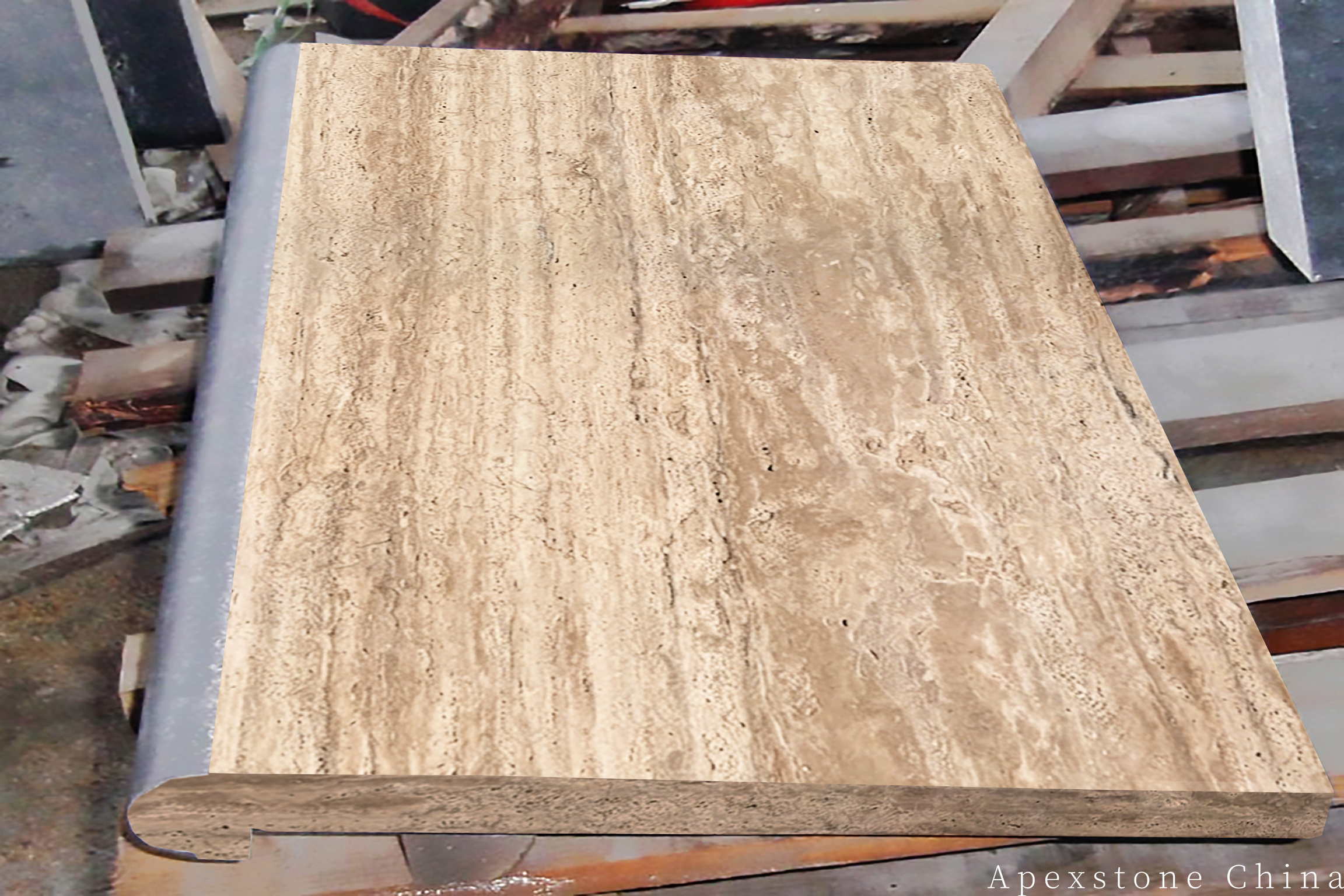
A field paver is a rectangular block with four square-cut edges. A coping unit is a paver with at least one edge machined into a finished profile — bullnose, eased, or a profile cut to your drawing. That nose is the part a bather sees first and touches with their hands and feet.
The practical consequence is that coping cannot be substituted with field tile. If you lay square-cut pavers around the pool shell, the cut face stays sharp and open, with a visible raw edge at the waterline. It also has no consistent profile to return against, so the coping line follows every small variation in the tile edge rather than reading as a true edge.
Coping is fabricated to the drawn plan: profile, radius at corners, and overall length are set per run. Where a pool has an inside or outside radius, or a spa spillway, those corner units are produced as bespoke pieces. That is why coping is quoted from a drawing rather than from a simple square-metre figure.
If you want a wider overview of how coping is categorised across stone types, see our notes on pool coping tiles in general; for the profile and sourcing side specifically, read stone coping for pools.
The specification that matters
Four decisions drive the whole order: thickness, edge profile, finish and thickness calibration.
| Specification item | Our standard for Travertine Romano pool coping | Why it is on the order |
|---|---|---|
| Thickness | 30 mm (1-1/4 inch) | Gives the coping enough mass to span the shell edge and read as a solid perimeter band against the deck. |
| Edge profile | Bullnose, eased, or custom to drawing | Sets how the edge looks and feels at the waterline; corners and radii are cut to plan. |
| Finish — wet area | Unfilled brushed or unfilled tumbled | Both give better grip underfoot at the wet edge than a honed face. |
| Finish — formal look | Filled honed | Smoother, more uniform appearance where the design calls for it. |
| Calibration | Calibrated thickness | Keeps a long edge run level; mismatched thickness shows up as lippage along the coping line. |
Thickness
Pool coping in our program is cut at 30 mm (1-1/4 inch). This is heavier than the deck pavers behind it and is specified separately — do not assume the coping will be cut from the same slab thickness as the 600x600 mm (24x24 inch) paving. It is a different line item.
Profile
Bullnose is the most common choice at a residential pool; eased is flatter and suits a more architectural edge. Custom profiles are cut to drawing. The profile is what you are paying for in coping, so it belongs on the drawing, not in a verbal instruction on the phone.
Finish
For the wet edge, unfilled brushed or unfilled tumbled surfaces grip better than a honed face. The trade-off is honest: unfilled travertine has open pores and will show marks, and it needs a different care expectation than a filled, honed tile. If your client wants a more formal, closed look, filled honed is available — just specify it as a deliberate choice, not a default.
Calibration
Calibrated thickness is what keeps a long edge run level. On a pool perimeter you may be laying 20 or 30 metres of coping in one continuous line; any variation in unit thickness transfers directly into the finished edge. Calibration is not a cosmetic upgrade.
Pairing coping with travertine deck pavers
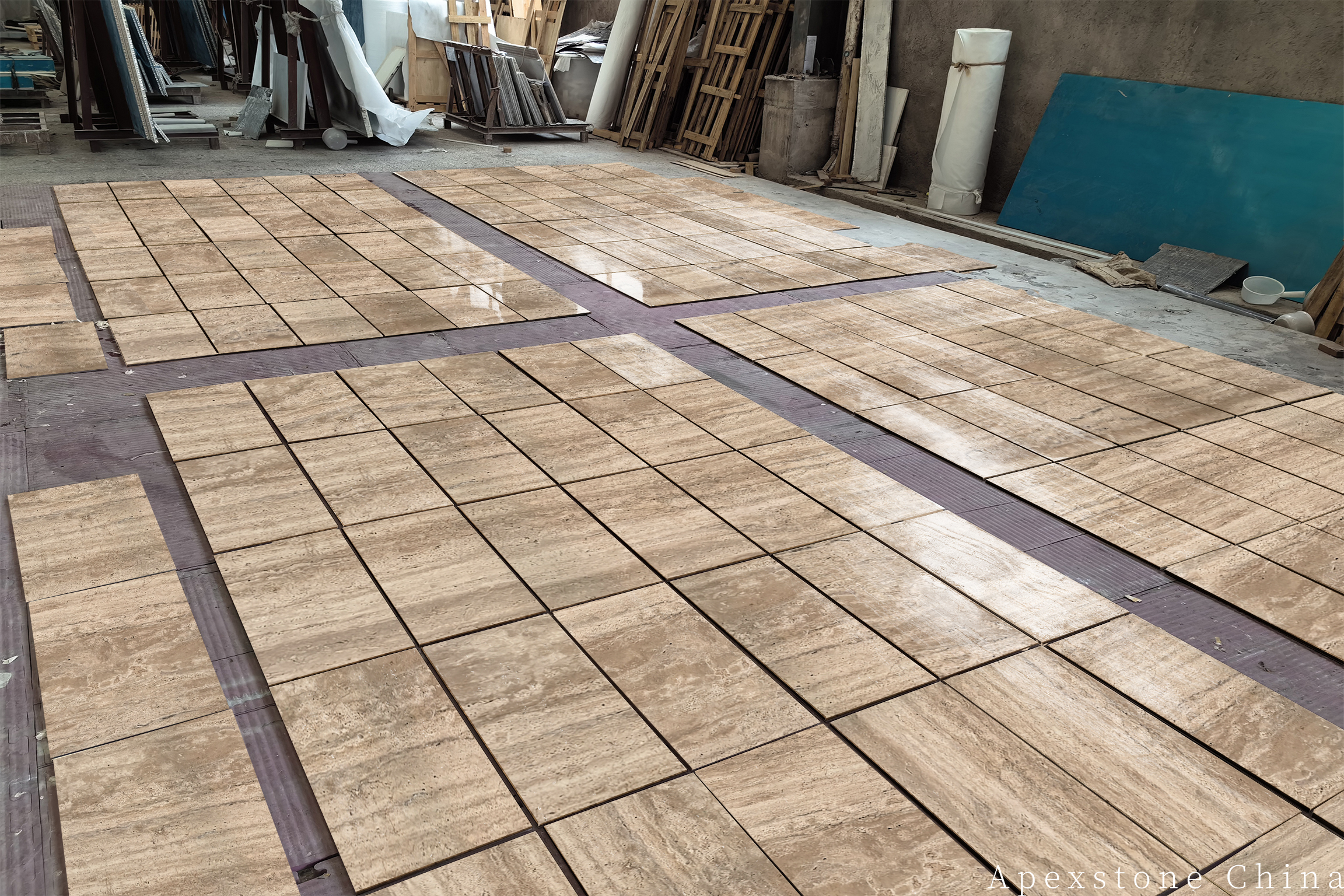
Coping and deck should be one coordinated order from one material batch where possible, because they meet along a single visible line and any tonal mismatch is permanent. In our program the deck side offers 600x600 mm (24x24 inch) pavers or French Pattern sets, both with calibrated thickness. Driveway-duty paving is available at 30 mm (1-1/4 inch) or 40 mm (1-1/2 inch) where the paved area takes vehicle loads.
Plan the two orders together rather than sequentially:
- Draw the coping runs first. Mark every straight run, corner radius and termination on the plan. Coping quantities come from that drawing, so a later layout change reopens the coping order.
- Fix the joint line before you fix the bond pattern. The deck pattern (600x600 or French Pattern) should start from the coping line, so the cut row sits against the coping rather than in the middle of the deck.
- Include step treads and risers in the same drawing. Step treads, risers and matching coping are supplied as coordinated sets, which keeps the pool edge and the steps reading as one installation.
- Confirm what the deck actually carries. A pool surround that takes only foot traffic and a driveway apron are different specifications — 40 mm paving is available when vehicle loading is in scope.
The full product range behind this is set out in our travertine coping and paving program, and the material-level detail is in the full travertine specification guide.
- Minimum order quantity and lead time are quoted per project against your specific drawings and quantity
- Coping, deck pavers, step treads and risers supplied as one coordinated set
- Samples of custom finishes or edge profiles are provided free of charge with bulk orders
Sealing and freeze-thaw discipline
An unfilled brushed or tumbled face generally feels cooler underfoot than a polished surface, which is one reason travertine is used around pools — how much cooler depends on the finish and on the sun exposure, so treat it as a difference in feel rather than a guaranteed temperature. It is not a maintenance-free surface. Sealing is required, and it should be a water-repellent penetrating sealer — not a film-forming coating that sits on the face and wears through at the nose of every coping unit.
In freeze-thaw climates, specify a premium-grade penetrating sealer. Water that enters an unfilled surface and then freezes is the main risk to the coping, and the sealer is the control measure: it lowers surface water absorption and so reduces freeze-thaw risk. How far that carries a given site still depends on the local freeze-thaw cycles and on how the installation drains, so it belongs in the specification as a control measure rather than a guarantee. This applies to both the coping and the deck, and it should be planned as part of the installation programme rather than left to the end of the build.
Two honest expectations to set with the client: unfilled finishes will grip better but will show their age; and any stone around a pool will need re-sealing on a maintenance cycle. Buyers who specify unfilled brushed coping get the safety benefit and should budget the care.
Before committing the tone, compare it against the other travertine option on the waterline: silver travertine coping versus ivory shows how the two read at the waterline and what each asks of the sealing specification.
FAQ
What thickness should travertine pool coping be?
In our program, pool coping from Travertine Romano is cut at 30 mm (1-1/4 inch). That differs from the 24x24 inch deck pavers, which are supplied at calibrated paving thickness, and from driveway-duty paving at 30 mm or 40 mm (1-1/2 inch). Specify coping as its own line item on the order, not as an offcut of the deck material.
Filled or unfilled around water?
Unfilled brushed or unfilled tumbled give better grip at a wet edge and are the common choice for poolside. Filled honed is available for a more formal look where the design calls for a closed, uniform surface. There is no single right answer — it is a trade between grip and appearance, and the care expectation differs between the two.
Can the coping and pavers ship together from one batch?
Yes — coping, deck pavers and matching step treads and risers are supplied as coordinated sets in our program, and the two should be ordered together so tone and thickness are matched. Both are quoted from the same drawing approval, with minimum order quantity and lead time quoted per project against that approved drawing.
Why is coping quoted from a drawing rather than by area?
Because the profile, corner radii and run lengths are cut to the pool layout. Until the drawing is approved, the coping quantity is an estimate. Once the drawing is fixed, the coping order, the deck joint line and the step set can all be released as one coordinated package.