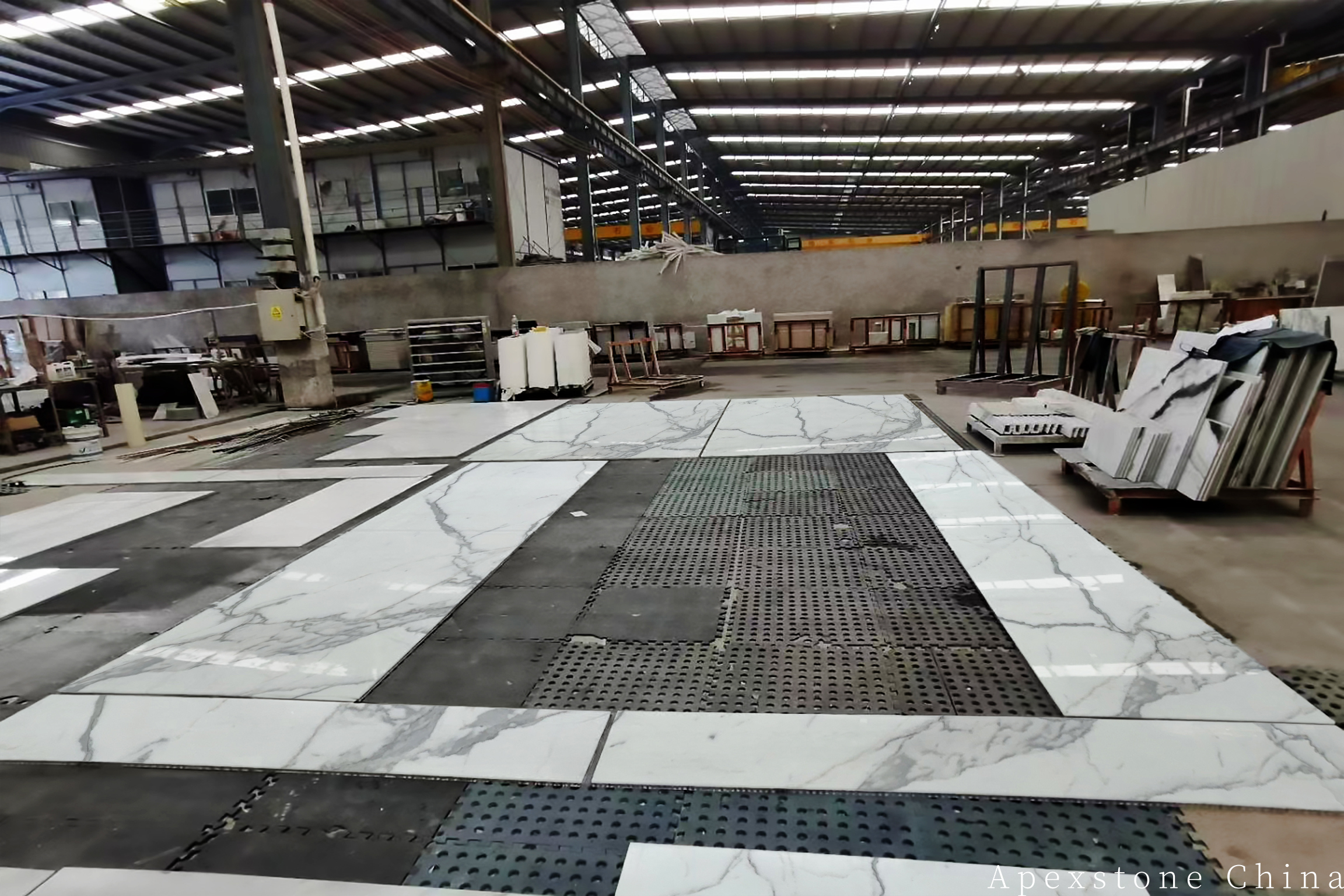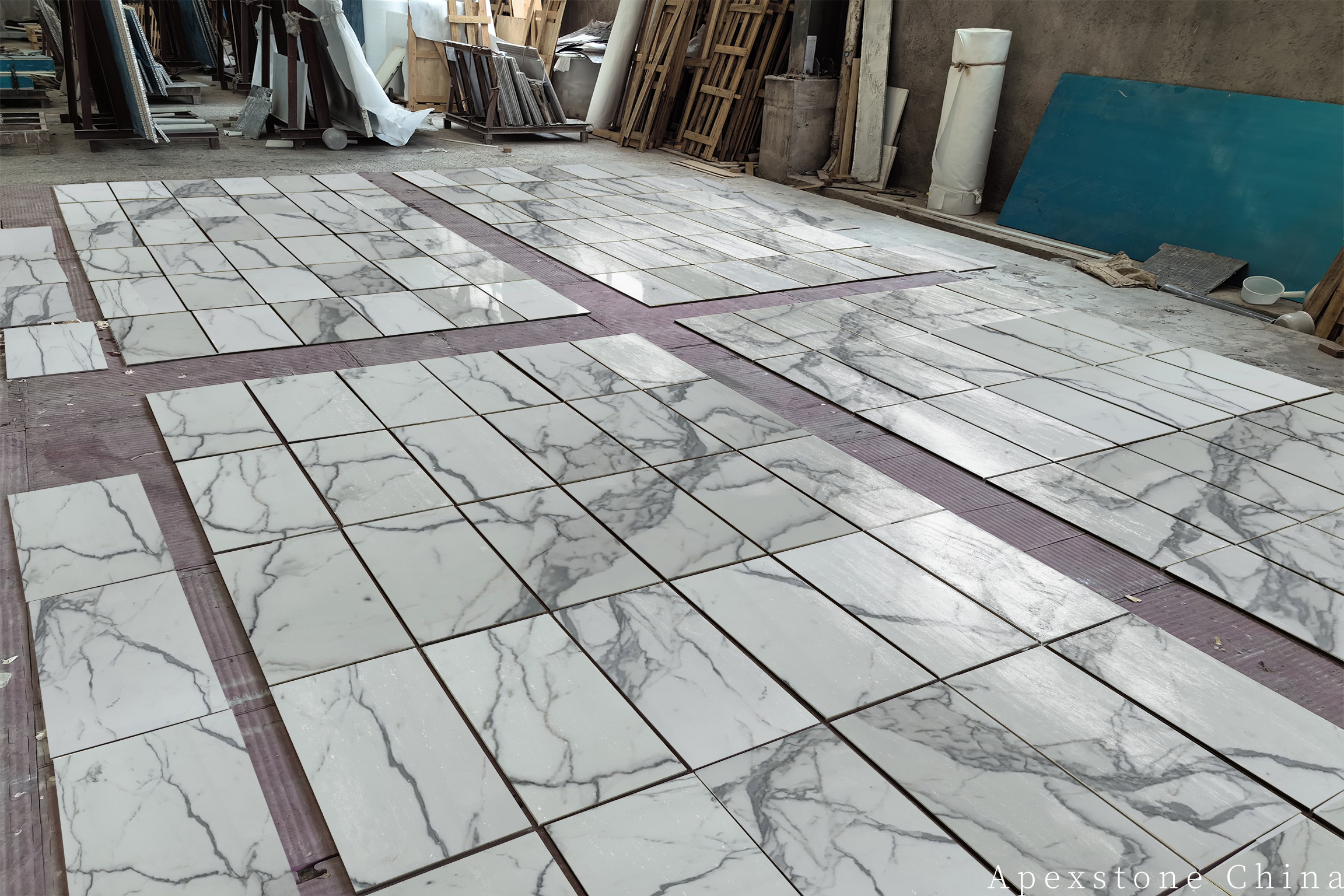
Calacatta White's snow-white ground makes acid etch rings stand out more than on busier marble. This guide explains why acids attack the calcite, the blot-don't-wipe habit for wine and citrus, a pH-neutral routine, how honed and polished surfaces respond differently, and the option of on-site re-polishing when wear accumulates.
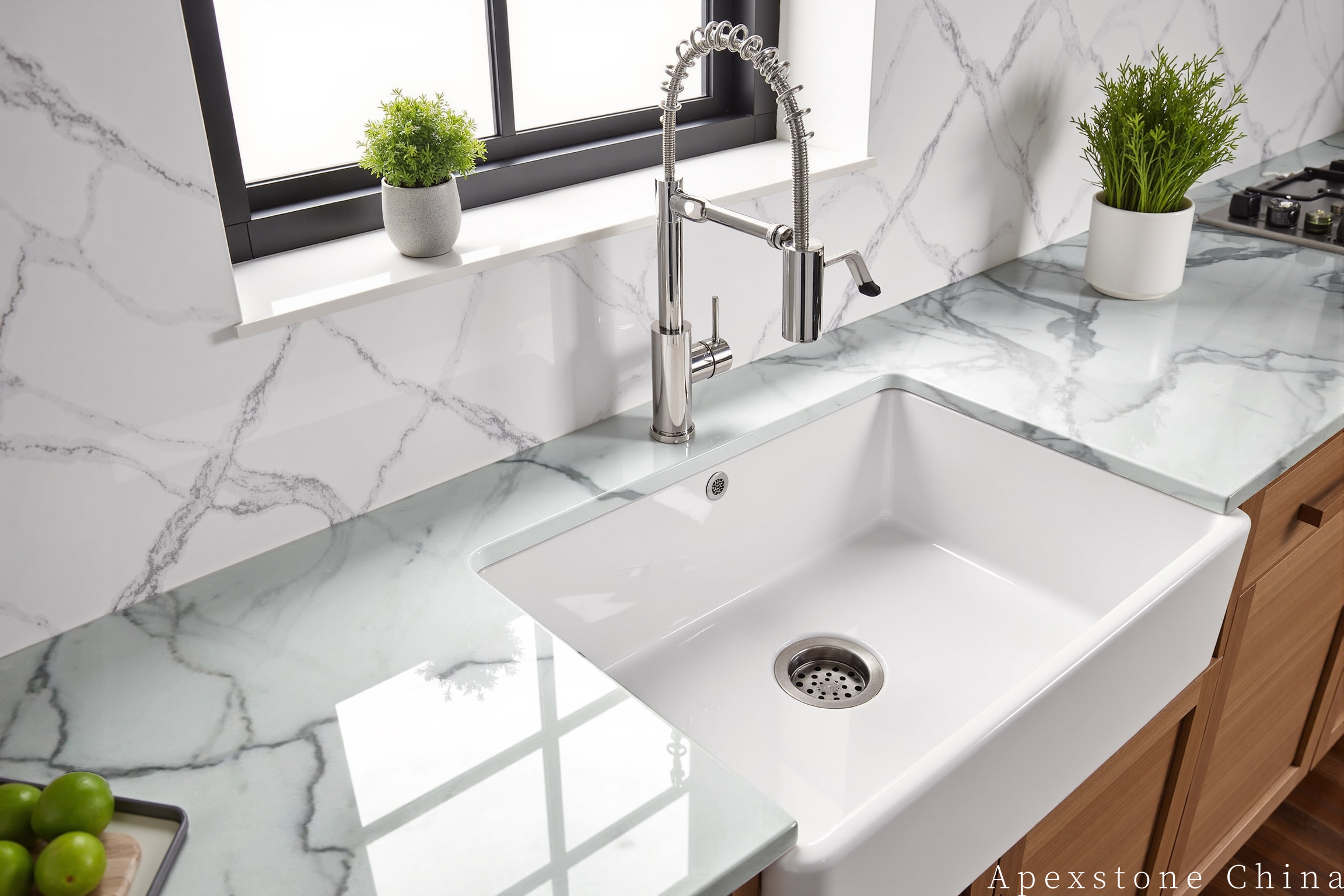
Calacatta White is an Italian natural marble with a snow-white ground and light-grey random veining. That white background is exactly why etch marks show up so clearly: a dull ring or a pale spot has nowhere to hide. On a busier stone, the veining breaks up the visual line. On Calacatta, every acid mark reads as a defect. This article explains why that happens, and how to clean calacatta marble so the white ground stays uniform.
- Calacatta is calcite-based, so any acid — wine, citrus, vinegar, many household cleaners — attacks the surface.
- Blot spills, don't wipe: wiping spreads the acid and enlarges the etch mark.
- Use a pH-neutral routine for daily cleaning; avoid acidic and abrasive products.
- Honed and polished surfaces respond differently to acid and to wear.
- Etching is a surface change, not a permanent stain — calcite marble surfaces can be re-polished on site when wear accumulates.
Why acids etch Calacatta White
Calacatta White is a calcite-based marble. Calcite reacts with acids. When an acidic liquid sits on the surface, it dissolves a thin layer of the stone at the contact point. The result is a dull, slightly recessed area — an etch mark — that scatters light differently from the surrounding polished or honed surface. On the snow-white ground of Calacatta, the contrast between the etched area and the intact surface is high, so the mark is visible even when it is shallow.
This is a chemical reaction, not a stain that sits on top of the stone. That distinction matters for cleaning: a stain can sometimes be drawn out, but an etch mark has changed the surface. The practical goal is prevention — keeping acids off the marble in the first place — and, when etching does occur, understanding that the surface can be restored by re-polishing rather than by scrubbing.
Common acids that reach a Calacatta top
- Wine, champagne, and other alcoholic drinks
- Citrus juice and citrus-based cleaners
- Vinegar and vinegar-based cleaning products
- Tomato sauce and other acidic foods
- Some bathroom and descaler products
The list is not exhaustive, but it covers most of what reaches a kitchen island or vanity top in daily use.
The blot-don't-wipe habit for wine and citrus
The single most useful habit for protecting a Calacatta surface is to blot, not wipe. Wiping a spill pushes the acidic liquid across a larger area and drives it into the surface. A small spill becomes a long smear-shaped etch mark. Blotting lifts the liquid without spreading it.
For wine, citrus juice, or any acidic spill:
- Place an absorbent cloth or paper towel directly on the spill and press gently. Do not drag it.
- Lift the cloth, replace it with a clean dry section, and repeat until no liquid transfers.
- Clean the area with a pH-neutral stone cleaner and a soft cloth, using light pressure.
- Dry the surface with a clean cloth. Do not leave the area wet.
Keep the response fast. The longer an acid stays on calcite, the deeper the reaction. A spill blotted within a minute or two is far less likely to leave a visible mark than one left standing.
For routine cleaning of a Calacatta countertop or island, the same principle applies: use a pH-neutral cleaner, a soft cloth, and minimal liquid. Rinse with a clean damp cloth and dry immediately. Avoid leaving puddles, especially around edges and seams.
A pH-neutral routine for daily and weekly care
Calacatta White responds best to a simple, pH-neutral routine. The goal is to remove soil without introducing acids or abrasives.
| Frequency | Task | What to use |
|---|---|---|
| Daily | Wipe down after use | pH-neutral stone cleaner, soft cloth, dry immediately |
| As needed | Blot acidic spills | Absorbent cloth, then pH-neutral cleaner |
| Weekly | Light cleaning of high-touch areas | pH-neutral cleaner, soft cloth, no standing water |
| Avoid | Acidic or abrasive products | Vinegar, citrus cleaners, scouring powders, harsh pads |
For vanity and countertop installations, sealing with a penetrating sealer is part of the care routine. Sealer helps limit liquid absorption, but it does not make Calacatta acid-proof. A sealed surface still etches if acid sits on it, so the blot-don't-wipe habit remains the first line of defense.
When cleaning, use a soft cloth or a non-abrasive pad. Abrasive pads can dull a polished surface mechanically, which is a different problem from etching but has a similar visual effect on a white ground.
Honed versus polished: different responses
Calacatta White is supplied in different surface finishes, and the finish changes how etching and wear appear.
Polished surfaces
A polished Calacatta surface has a high-gloss reflectivity. An etch mark on polished stone appears as a dull spot that interrupts the reflection — it is easy to see because the surrounding surface is mirror-like. Polished surfaces also show fine scratches and wear more readily under bright light.
Honed surfaces
A honed surface has a matte or low-sheen finish. Etch marks are less visually sharp because there is no high-gloss reflection to break, but the surface can still be affected by acid. Honed finishes tend to hide everyday wear better, which is one reason they are chosen for busy areas. The trade-off is that the matte surface can hold soil differently, so routine cleaning should be consistent.
Neither finish is immune to acid. The difference is in how visible an etch mark becomes and how the surface responds to re-polishing when wear accumulates.
What to do when an etch mark appears
If a mark does appear, avoid aggressive scrubbing. Scrubbing an etched area does not restore the surface and can widen the dull zone. The effective remedy for calcite marble is re-polishing, which removes the damaged layer and restores the finish.
Calcite marble surfaces can be re-polished on site. For a countertop or island, this is typically a localized process: the affected area is re-polished to match the surrounding finish. On a polished top, the restorer works to bring back the gloss; on a honed top, the goal is to restore the uniform matte appearance. Re-polishing is a maintenance step, not a replacement — it addresses surface wear and etching without changing the slab.
For buyers specifying Calacatta White for a project, this is worth knowing: the stone is repairable. Etching is a surface condition that can be corrected, which is different from a crack or a structural fault.
Prevention checklist for Calacatta White tops
- Use coasters and trivets; wipe up spills immediately.
- Blot acidic spills — never wipe them across the surface.
- Keep a pH-neutral stone cleaner on hand for daily use.
- Seal vanity and countertop installations with a penetrating sealer as part of routine care.
- Avoid vinegar, citrus cleaners, and abrasive pads on the stone.
- Schedule re-polishing when wear accumulates or when etch marks become visible.
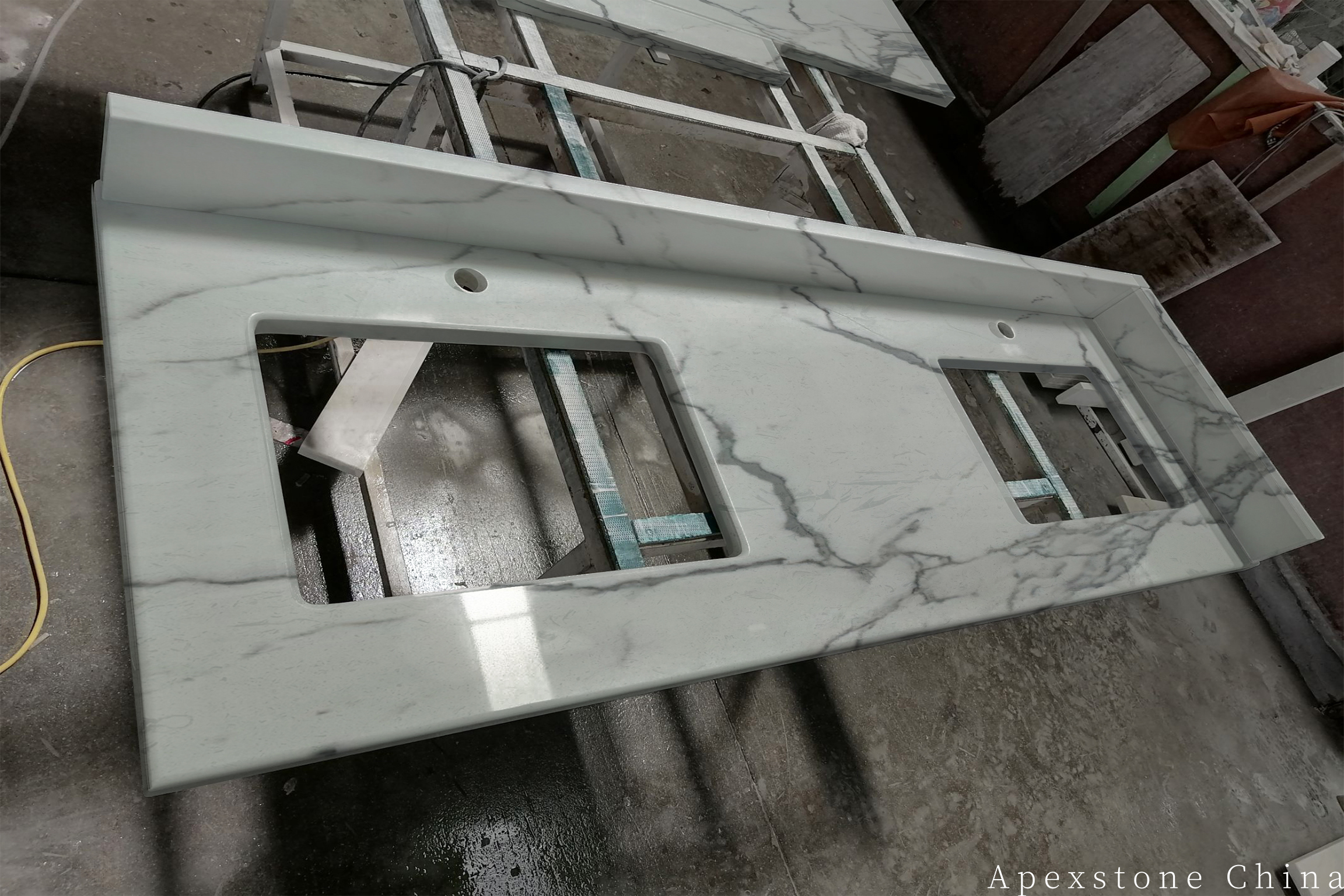
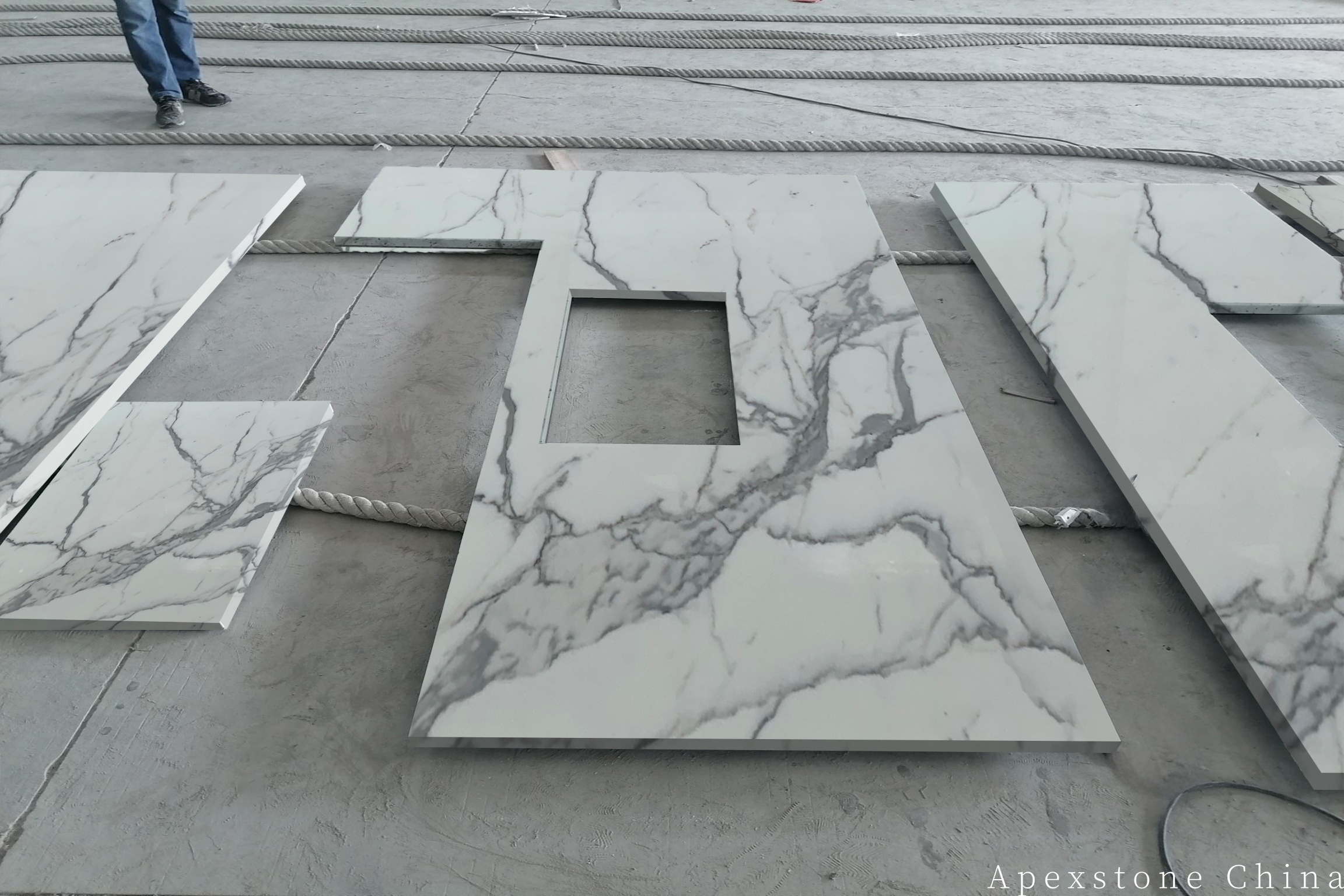
Calacatta White is machined and finished to project requirements. Countertops and islands are CNC-machined with cutouts from approved drawings, so the edge profile, cutout placement, and surface finish are set before the stone reaches the site. Knowing the finish helps the owner choose the right cleaning routine from day one.
For specifications and available formats, see the Calacatta White marble countertops and islands page.
FAQ
Does sealing prevent etching on Calacatta White?
Sealing with a penetrating sealer is recommended for vanity and countertop installations, but it does not make the surface acid-proof. Calacatta is calcite-based, so acid can still etch a sealed surface. Sealer helps limit absorption; the blot-don't-wipe habit remains essential.
Can an etch mark be removed without re-polishing?
Etching is a surface change, not a stain. Scrubbing does not restore the surface. Re-polishing is the effective method, and calcite marble surfaces can be re-polished on site.
Is honed Calacatta easier to maintain than polished?
Honed surfaces hide etch marks and everyday wear better because there is no high-gloss reflection to break. Both finishes are sensitive to acid. The choice depends on the look and the expected traffic.
What cleaner should be used daily?
A pH-neutral stone cleaner with a soft cloth, followed by drying the surface. Avoid acidic and abrasive products.