
Procurement Solution
Marble Tile Supply: Lot-Mapped Fields, Calibrated on One Line
Marble tile orders fail by lot, not by module: uncontrolled lots arrive as a patchwork once fixed. We map the lot, calibrate on one line and pack crates in laying order — so the field reads as one stone.
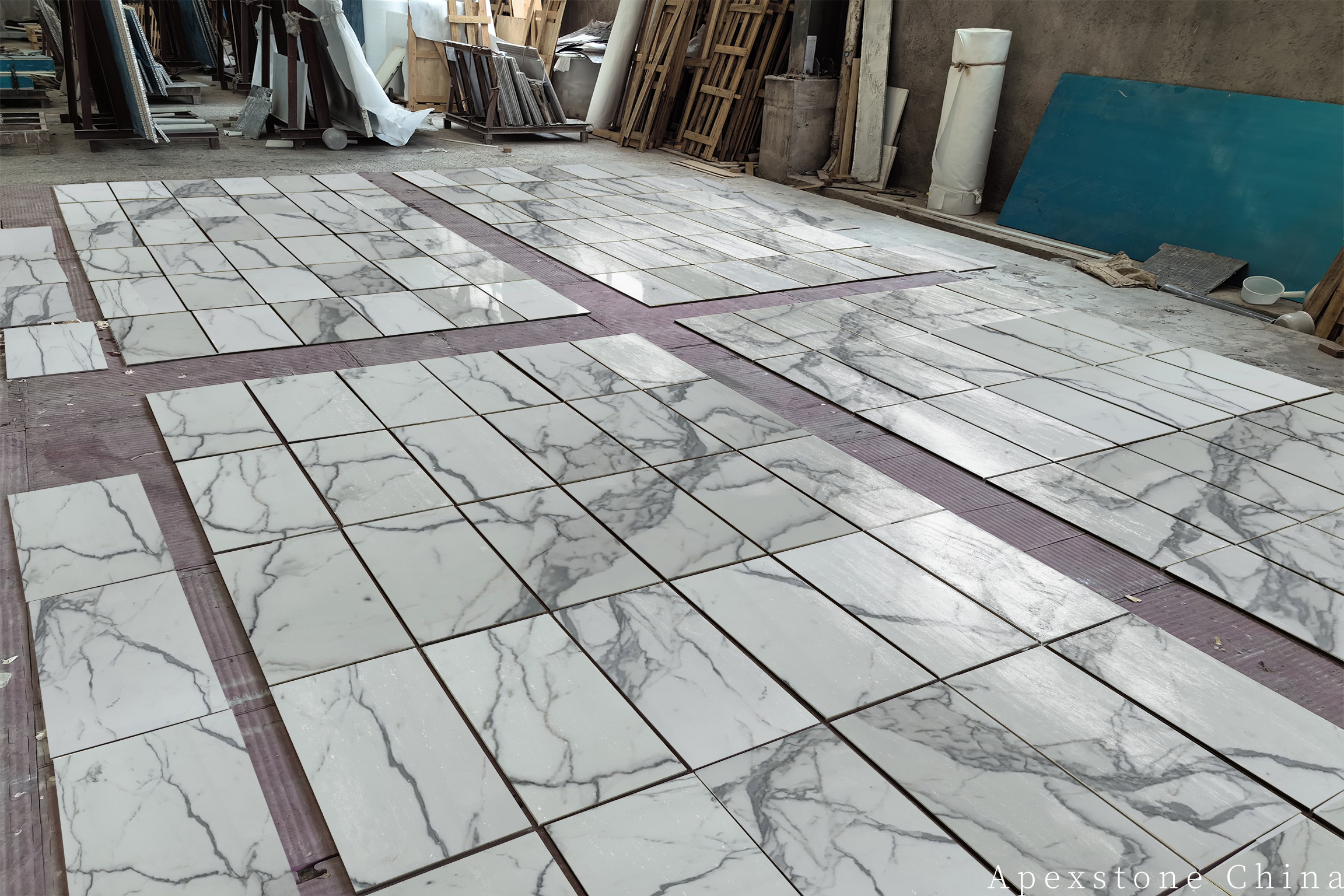
The buyer's pain point and our technical solution
Buying from marble tile suppliers on price and square metres alone inherits a lottery. Marble is sold by lot, and every lot mixes calm pieces with strongly veined ones — so a tile order placed with an uncontrolled supplier arrives as a patchwork: one crate quiet, one heavily veined, one in between. Once the field is fixed, the veined pieces sit next to the quiet ones at a grout line and the elevation reads as three different stones. The bill rarely arrives as a formal claim; it arrives as a setter sorting crates for a day, a quiet piece running out mid-field, and a supplementary order crossing another ocean.
What uncontrolled tile supply costs the buyer
Delay and margin loss, mostly invisible: scheduled fixing days lost to sorting, grout colours approved against samples that no longer match what landed, and phases of the same building reading differently because each phase drew from a different lot. All of it was preventable at the factory stage.
Our solution: lot mapping, same-line calibration, crate-level packing
- One lot, mapped and photographed: pieces for one order are selected and blended by QC so veined and quiet faces distribute deliberately across crates; large fields are approved with lot samples and dry-lay photographs of the actual crates before release.
- Same-line calibration: the order is cut and calibrated on one line, so thickness and squareness stay consistent across the whole field — the precondition for flat installation without lipping.
- Market modules: 12 x 12 in, 12 x 24 in, 18 x 18 in, 24 x 24 in and 24 x 48 in (300 x 300 through 600 x 1200 mm), plus subway, hexagon and herringbone formats and cut-to-size, planned in one run.
- Crate-level packing plans: crates labelled by lot, module and installation order, so the setter opens the crates in the sequence the field is laid.
- Programme scale: quantities flexible from sample programmes to full container loads; repeat phases planned under the same shade controls with current-lot images before commit.
Value for the buyer
You control which lot feeds which area — the variable that actually decides how a marble field reads — instead of inheriting it.
Documented project cases
Hotel corridor field mapped by lot before release
- Client / commission
- Hotel project contractor, Middle East
- Stone used
- Calacatta White marble floor tiles, 12 x 24 in (300 x 600 mm), honed
- What it solved
- Long corridor fields show veining distribution directly; uncontrolled lots read as a patchwork once fixed
- Before
- Installer sorted crates on site for a scheduled fixing day and the quiet pieces ran out mid-field
- Now
- Lot samples and dry-lay photographs of the actual crates approved before production release; field fixed without sorting or gaps
- Where the data comes from
- Project order records and dry-lay photo approval
Mixed-module container consolidation for a tile retailer
- Client / commission
- Tile retailer, North America
- Stone used
- Calacatta White tiles, Red Sandalwood mosaic and travertine modules in one container
- What it solved
- Retailer bought formats from separate suppliers; freight and receiving costs multiplied and lots never matched in-store
- Before
- Three inbound shipments per replenishment cycle, three customs entries, three sets of lot risk
- Now
- Mixed modules planned in one production run and loaded in one container, crates labelled by area and installation order
- Where the data comes from
- Company order records and packing plan
Shade-controlled repeat order for an apartment developer
- Client / commission
- Apartment developer, repeat phases
- Stone used
- Calacatta White wall tiles, phased bathroom program
- What it solved
- Phase-two tiles from a new lot risked reading differently next to phase one in the same building
- Before
- Original lot exhausted before the phase was complete; supplementary order started another production cycle
- Now
- Repeat order planned under the same lot-mapping and shade controls with current-lot images supplied for comparison before commit
- Where the data comes from
- Company order records and repeat-order file
Client reviews and ratings
Client reviews on file for marble tile programmes (star ratings drawn from our order records and follow-up notes):
- ★★★★★
Tile retailer, North America: “One container instead of three changed our receiving economics — and the crates opened in laying order.” Verifiable result: mixed-module consolidation from three inbound shipments to one per cycle (source: order records and packing plan).
- ★★★★☆
Hotel project contractor: “The dry-lay photos matched what we opened on site. Customs clearance took longer than planned, but the material itself was exactly as approved.” Verifiable result: field fixed without on-site sorting or gaps (source: project order records and dry-lay photo approval).
- ★★★★★
Apartment developer, phased program: “Phase two reads the same as phase one because the lot controls carried across orders.” Verifiable result: repeat phases planned under the same shade controls (source: repeat-order file).
Certificates and compliance records
ISO-certified production processes
Tile calibration, shade control and pre-shipment inspection run under our documented ISO-certified process controls; certificate scope and validity are provided with quotations on request.
Material standards per company records
Our sourcing documentation lists ASTM C503 standard compliance for marble tile selections. Standards documents are provided with quotations on request; we do not claim certification beyond what is on file.
Company strength
Apexstone Amoy Marble and Granite, founded in 2002, exports to 42 countries from Xiamen, China. Marble tile supply runs on same-line calibration, lot mapping and crate-level packing plans under ISO-certified process controls, with full inspection before packing documented in our factory records.
Sourcing runs through our Shuitou hub — 2,400+ natural stone types with 85% direct quarry buying from Italy, Turkey, Iran, Brazil, Spain and China. R&D includes the StoneGPS.cn platform, developed over three years, which archives high-definition scans (≥300 dpi) searchable by stone type, origin, colour and vein; The StoneBooks reference collection, commissioned by Harvest Asia Pacific (Hongkong) Ltd., is used by institutions including Cendes Design Studio, Shanghai Institute of Visual Art (Fudan University), National Cheng Kung University and the National Taiwan Museum.
Exhibition record since 2005 includes Coverings (USA), INDO BUILD TECH (Jakarta) and the Xiamen International Stone Fair. Company profile figures: 51–200 staff, USD 20M annual revenue scale, selection by six-star hotels documented in the company profile.
Related products
Calacatta White Marble Tiles
Calacatta White marble tiles for floors, walls, backsplashes and bathrooms in the modules the market actually asks for — 12 x 12 in, 12 x 24 in, 18 x 18 in, 24 x 24 in and 24 x 48 in — with honed or polished finish, subway, hexagon and herringbone formats, and lot-mixing guidance for installers.
Red Sandalwood Marble Mosaic Tiles - 3D, Basketweave & Splitting Formats
Red Sandalwood (紫檀金沙) marble mosaic tiles in 3D, basketweave, cubic, and splitting face formats. Purple base with wood-grain diagonal stripe veining. Mesh-mounted sheets 300x300 mm for feature walls, kitchen backsplashes, bathroom accent panels, and decorative floor inlays. Mosaic tile supplier Apexstone - 42+ countries since 2002.
Calacatta White Marble Feature Wall Panels
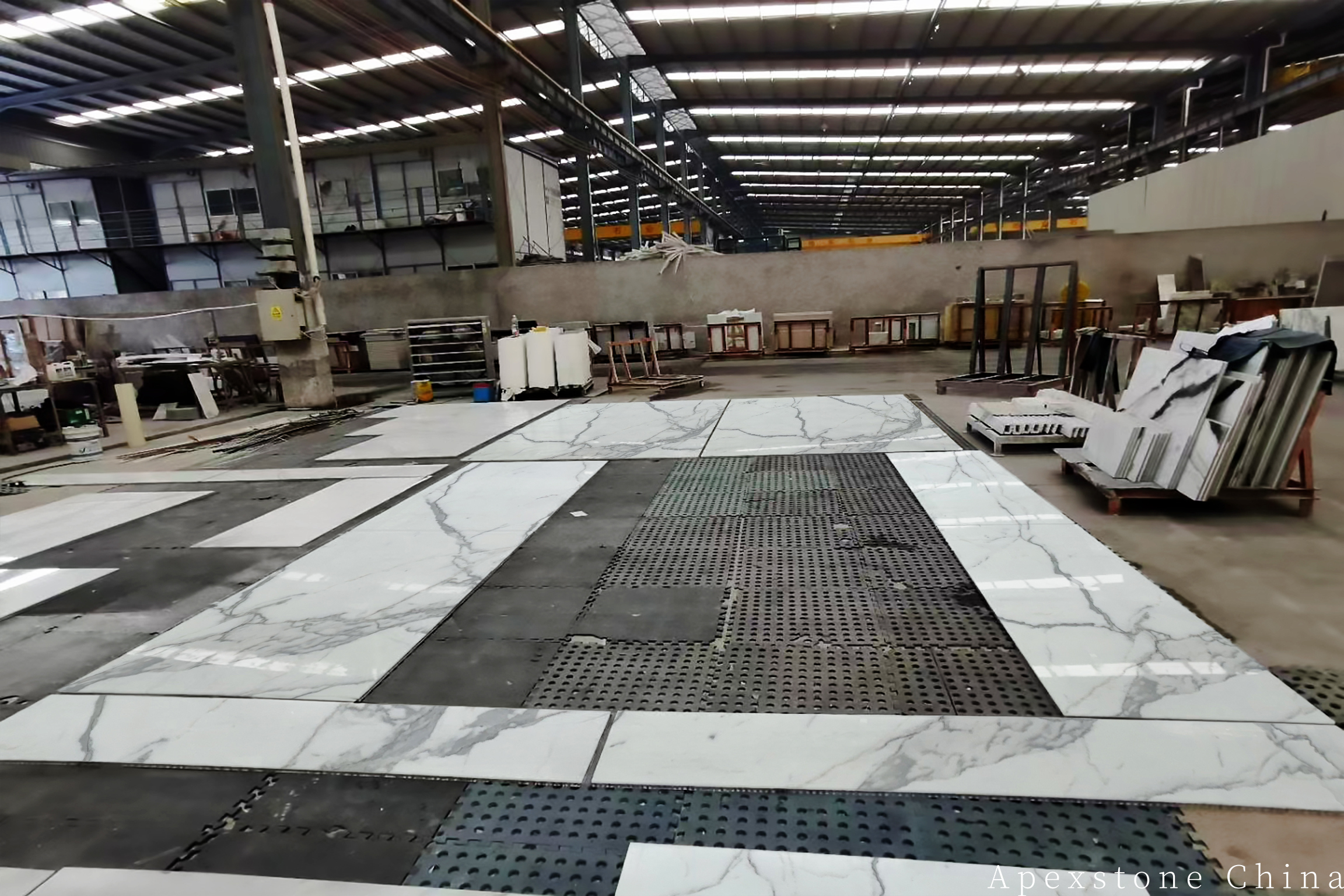
Calacatta White feature wall panels developed from an elevation and actual-slab layout. Large-format, sequential or mirrored compositions with 20 mm (about 3/4 in) reference thickness and project-engineered support.
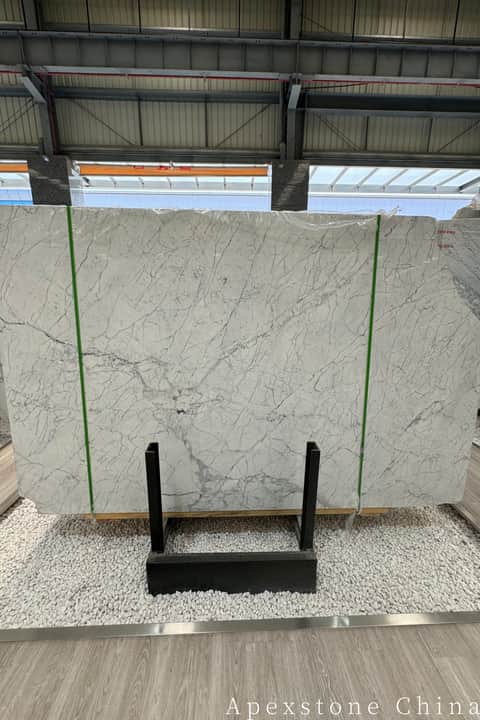
Statuario Venato Marble Feature Wall
Statuario Venato marble feature walls made from book-matched, large-format panels for living rooms, fireplace surrounds, hotel lobbies and decorative interiors.
Match the tile module and finish to your surface
Select an option in each group to see the matching production rule.
Procurement FAQ
- Can you supply marble tiles as a programme, not just one container?
- Yes. Tile supply is planned as a programme: lots are mapped and photographed, formats are scheduled in one production run where possible, and crate-level packing follows your installation sequence — so repeat phases stay controlled.
- How do you prevent the mixed-lot patchwork problem?
- Shade and colour control inside every batch: pieces are selected and blended by our QC team so veined and quiet faces distribute deliberately across crates, and dry-lay photographs of actual crates are approved before release for large fields.
- Which modules do buyers order most?
- 12 x 12 in, 12 x 24 in, 18 x 18 in, 24 x 24 in and 24 x 48 in (with metric equivalents 300 x 300 through 600 x 1200 mm), plus subway, hexagon and herringbone formats and cut-to-size.
- Can floor tiles, wall tiles and mosaics ship together?
- Yes — mixed modules and matching pieces are planned in one run and loaded in one container, with crates labelled by area and installation order.
- What is the minimum order?
- Quantities are flexible from sample programmes to full container loads; a showroom display or single-bathroom renovation follows the same lot controls as a hotel field.
Request a lot-mapped marble tile quotation
Send the tile schedule — module, quantity with waste allowance, thickness, finish and destination port — and tell us which surfaces must read as one field. We reply with a lot-mapped quotation and crate-level packing plan.