Engineered marble, cultured marble and natural marble are three different products that buyers often lump together. This guide explains how each is made, what that means for vanity top specification, and gives trade buyers a decision framework covering sizing, edge work, sink cutouts and wet-area finish choice.
Materials · Buyer Guide
Three products get called "marble" in bathroom vanity sourcing: engineered marble, cultured marble and natural marble slab. They are made differently, behave differently on a vanity top, and suit different price points and order profiles. This guide separates them and gives purchasing teams a framework for choosing, rather than a single recommendation.
Key takeaways
- Engineered marble is crushed natural marble bound with resin and pressed; the pattern is engineered, so the same pattern can be repeated across many tops.
- Cultured marble is a molded composite with a gel-coat surface layer; shape and integrated bowls come from the mold, not from cutting slab.
- Natural marble slab is quarried stone; resin is not part of the material, veining is unrepeatable, and the surface can be re-honed later.
- The right choice depends on repeatability, design intent, edge and cutout requirements, and how the surface will be maintained over years of use.
What Is Engineered Marble Vanity Top? A Working Definition
If you ask what is engineered marble vanity top in sourcing terms, the answer is a composite: crushed natural marble is mixed with resin and formed under pressure into sheets or blocks, then cut, edged and drilled into a vanity top. Because the stone is ground before it is bonded, the visual result is designed at the factory rather than dictated by a quarry block. A pattern can be specified, matched across a production run, and repeated on a reorder.
That is the practical distinction from natural slab. A natural Calacatta White slab carries a specific vein layout that will not occur again; a buyer selecting natural stone accepts variation as part of the product. Engineered marble trades that uniqueness for consistency, which matters when a project needs forty tops that read as the same product installed in forty bathrooms.
Engineered marble is also not the same as cultured marble, even though the two are frequently used interchangeably in trade conversations. The next section separates them, because the confusion causes spec errors at the sample stage.
Engineered Marble vs Cultured Marble vs Natural Marble Slab
| Attribute | Engineered marble | Cultured marble | Natural marble slab |
|---|---|---|---|
| Construction | Crushed natural marble bonded with resin, formed under pressure | Molded composite with a gel-coat surface layer | Quarried stone, cut and finished |
| Pattern | Engineered; can be repeated across batches | Usually uniform or lightly veined through the mold | Unrepeatable natural veining |
| Shape freedom | Cut and edged from sheet or block | Shape and integral bowl defined by the mold | Cut from slab; shape limited by slab size |
| Surface renewal | Depends on construction and finish; confirm with supplier | Gel-coat is a surface layer; repair approach differs from stone | Can be re-honed |
| Best suited to | Repeatable specs, multi-unit projects, pattern consistency | Integrated one-piece look, molded shapes | Feature bathrooms, unique veining, long-life renovation |
The gel-coat point is the one most often missed. A cultured marble top carries its color and sheen in a surface layer over the molded body; a natural slab carries its appearance through the full thickness of the stone. Engineered marble sits between them in the sense that the appearance comes from the stone-and-resin body, while the finished face is produced by cutting and finishing rather than by a molded coating.
None of these is automatically better. A molded cultured marble top can deliver a seamless bowl-to-deck transition that a cut slab cannot. A natural slab can be refinished years later in a way a coated surface cannot. Engineered marble's argument is repeatability and design control at volume.
Where Engineered Marble Earns Its Place
- Pattern consistency across an order. Hospitality, multi-family and development projects often need identical tops in many rooms. Engineered patterns can be specified and repeated; natural veining cannot.
- Predictable fabrication. Because the material is produced to a specification, cutting, edge profiling and sink cutouts follow a repeatable program.
- Design flexibility within a defined palette. Buyers can choose a pattern direction and color family and have it held across production, which is difficult with slab selection.
- Straightforward specification conversations. Widths, depths, thicknesses and cutout positions can be written into a purchase order without slab-layout negotiation.
Limits Buyers Need to Plan Around
Engineered marble is a composite, and the specification should treat it as one. Resin content, filler grading and pressing method are supplier-specific variables. Buyers should ask for the supplier's own material documentation for the exact product being quoted rather than assuming performance carries over from another factory or another pattern.
- Heat and chemical exposure. Composite surfaces are not stone throughout. Confirm the supplier's stated care guidance for heat, solvents and abrasives before specifying for a hot-tool environment or a commercial cleaning regime.
- Repairability. Deep scratches or chips on a composite are handled differently from natural stone, which can be re-honed. Ask how the supplier expects a damaged top to be treated on site, and whether replacement or repair is the realistic path.
- Edge and cutout detailing. The edge profile, the sink cutout method and the tolerance on cutout position all affect installation. These should be fixed at the drawing stage, not discovered on site.
- Sampling discipline. Approve a physical sample of the actual pattern and finish, not a catalog image. Engineered patterns can vary between production lots even when the design is the same.
Where a project requires documented performance data or certification, ask the supplier for the test report that applies to the specific product and production batch being quoted. Do not assume a report for one pattern covers another.
A Decision Framework for Trade Buyers
Rather than declaring one material the winner, work through these four questions in order. The answers usually narrow the choice quickly.
1. Does the project need repeatability or uniqueness?
If forty bathrooms must look the same, or a reorder in eight months must match, engineered marble or a controlled composite is the practical route. If the design intent is a feature bathroom with veining that no other unit has, natural slab is the answer and the variation is the point.
2. How complex is the shape?
A rectangular top with a cutout and an edge profile suits cut-and-fabricate materials. An integrated bowl with a molded transition is a cultured marble strength. Match the material to the geometry, not the other way around.
3. What is the maintenance plan over the asset's life?
If the building owner expects to refinish surfaces after years of use, natural stone's re-honing capability is a real advantage. If the plan is replace-on-damage, the repairability question matters less and consistency of replacement supply matters more.
4. What can the supplier actually document?
Request the material specification, the care instructions and any test documentation for the exact product. A supplier who can answer specifically for the quoted item is easier to hold to a standard than one who answers in generalities.
The Natural Stone Option, With Real Sizing
For buyers who land on natural stone, the specification usually resolves into one of two directions: a white marble look or a warm, textured finish.
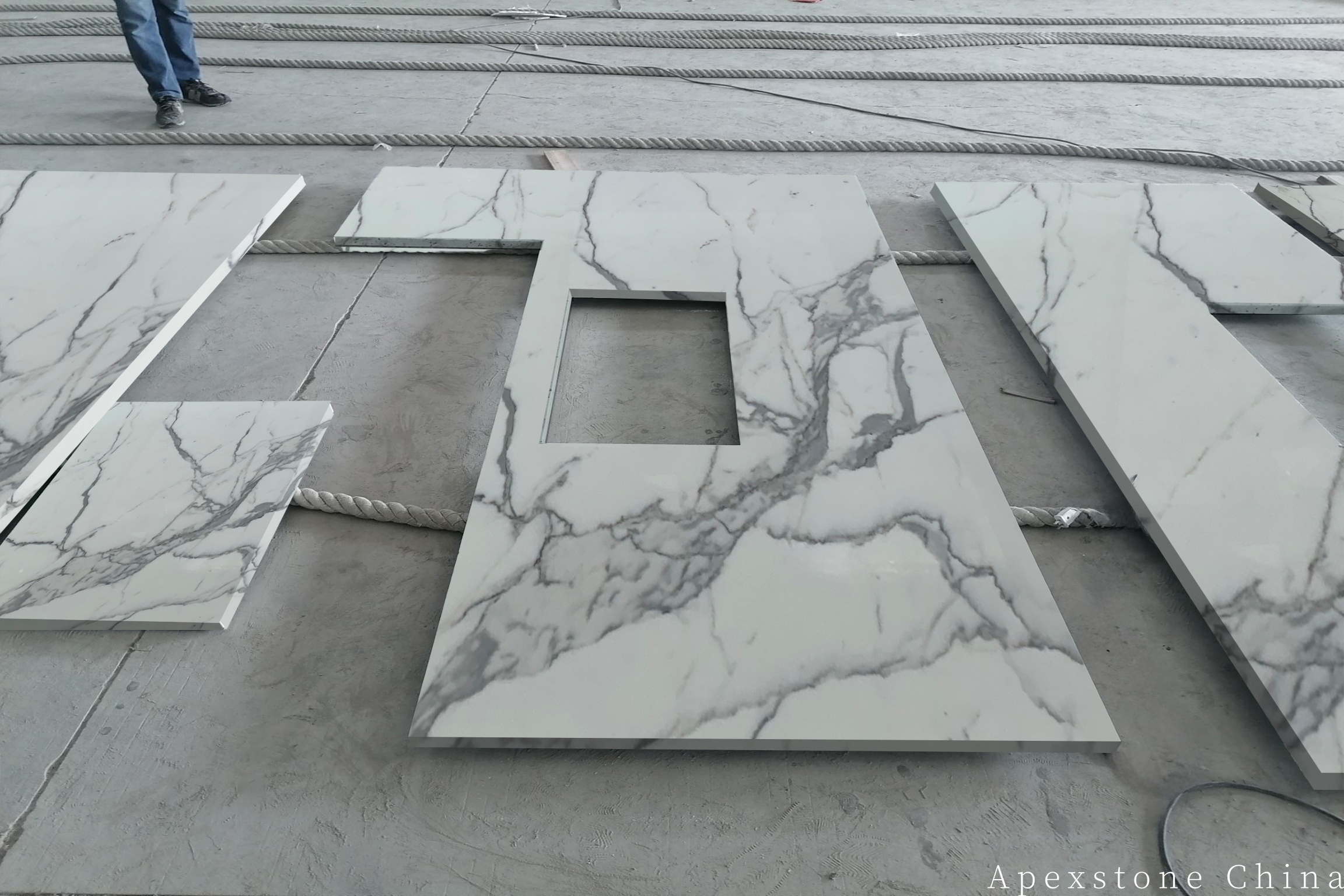
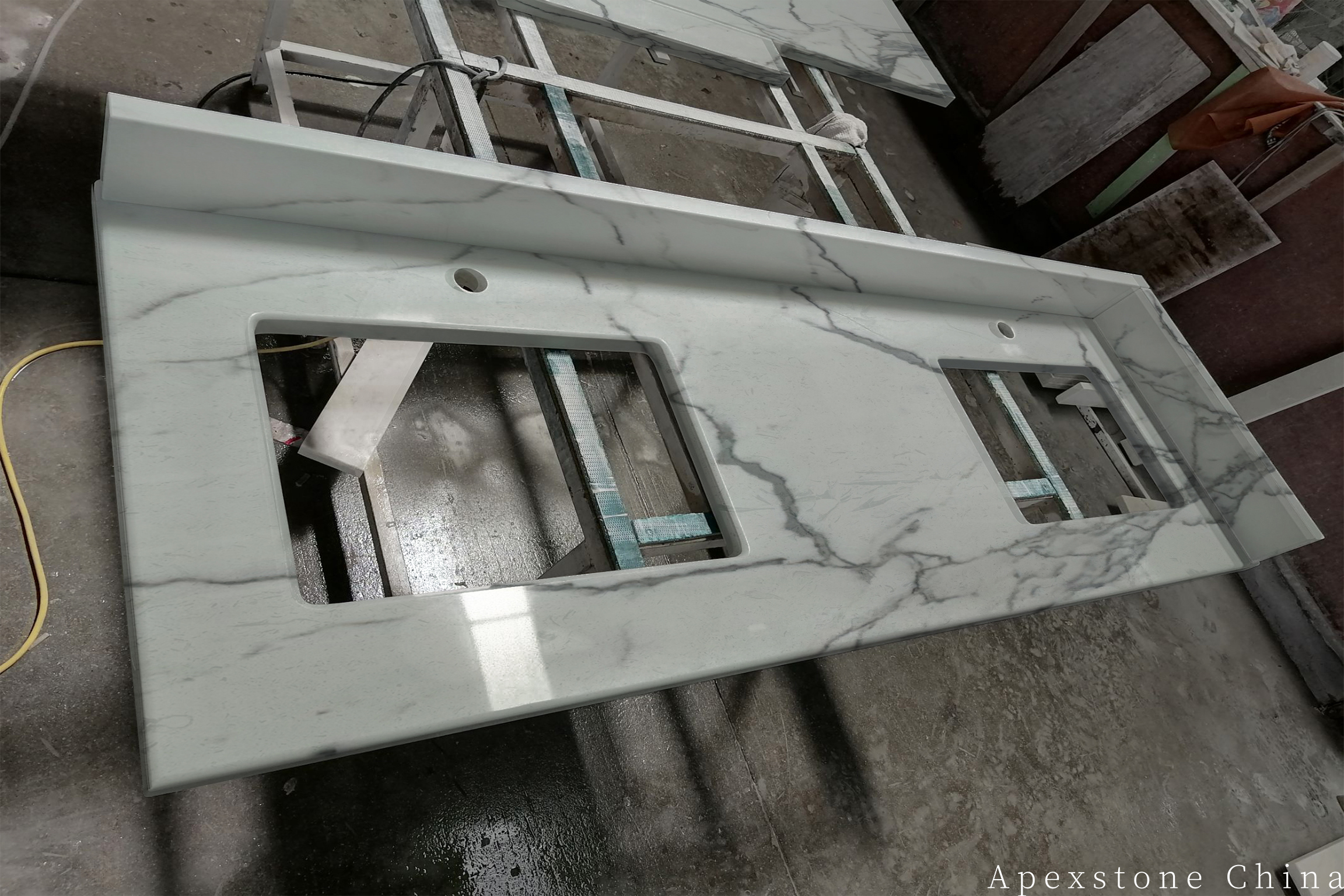
Calacatta White marble vanity tops are available in single widths of 25.5, 31 and 37 inches and double widths of 60 and 72 inches, at a depth of 21–22 inches and a thickness of 20 or 30 mm. That range covers most standard single and double vanity cabinets, with the 20 mm option suiting a slimmer edge and the 30 mm option giving a heavier deck profile. The unrepeatable veining is the reason to choose it, and also the reason a buyer should view the actual slabs or approved samples before committing to a multi-unit order.
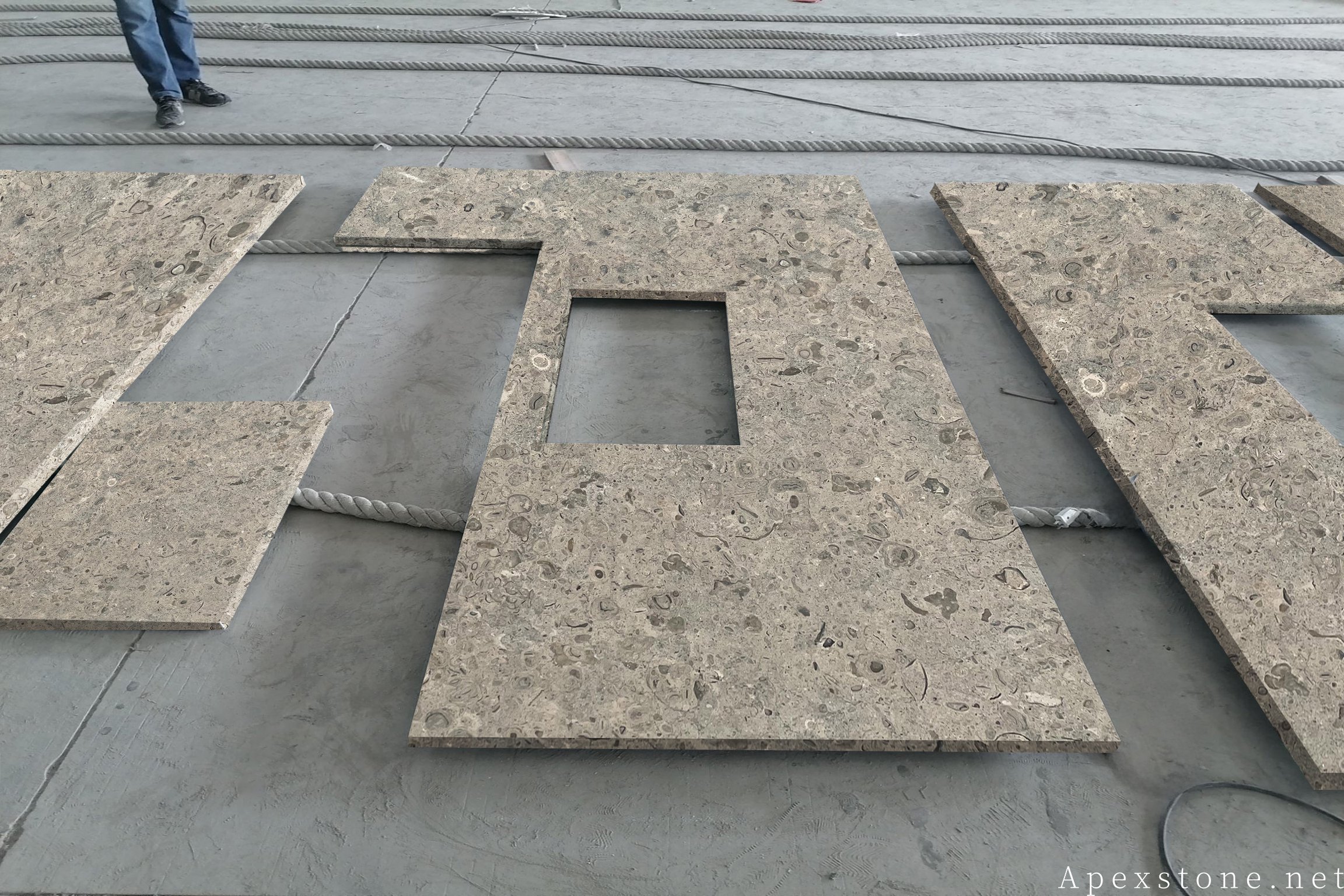
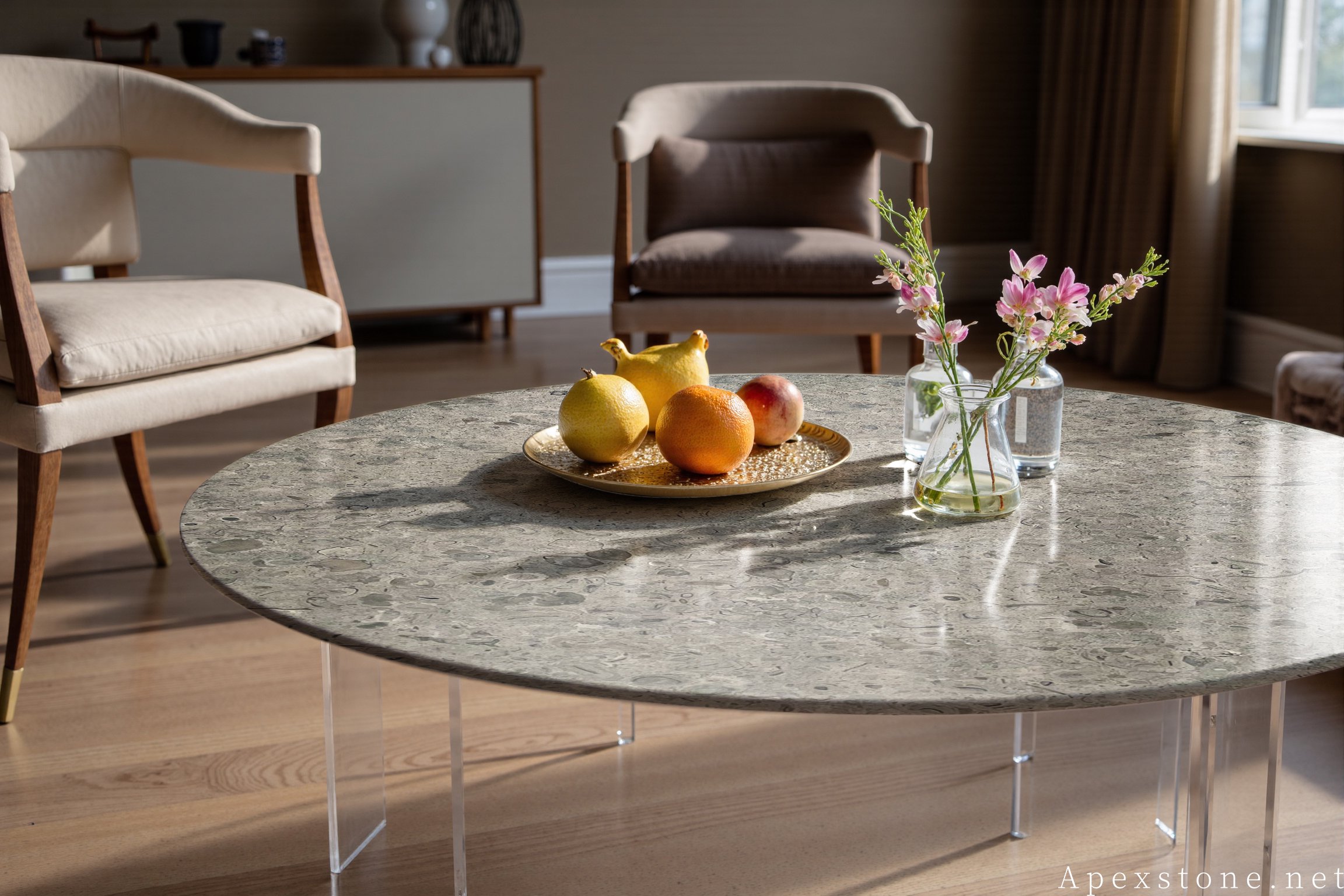
Travertine Romano vanity tops take a different route: a filled and honed finish, which is the standard approach for a wet area because the surface is closed and matte rather than polished. Widths run from 600 to 1800 mm (24 to 71 inches) with a depth of 500–600 mm, and sink cutouts are produced by CNC. The CNC point matters for buyers working to a drawing: cutout position and shape can be set from the project file rather than by hand marking.
Both are products where the buyer should confirm the current specification, finish and available sizes against the project drawing before releasing the order. See the Calacatta White marble bathroom vanity tops and the Travertine Romano bathroom vanity tops pages for the current product details.
FAQ
Is engineered marble the same as cultured marble?
No. Engineered marble is crushed natural marble bonded with resin and formed under pressure, then cut and finished. Cultured marble is a molded composite with a gel-coat surface layer, where shape and often the bowl come from the mold. They are different constructions and should be specified separately.
Can engineered marble be repaired like natural stone?
Not in the same way. Natural marble slab can be re-honed. Composite surfaces are handled according to the supplier's guidance, which varies by construction and finish. Ask the supplier how a damaged top should be treated before specifying.
Why choose engineered marble over natural slab for a hotel project?
Repeatability. A hotel with many identical bathrooms needs tops that match across rooms and across reorders. Natural veining is unrepeatable, so a natural slab specification accepts variation by design.
What sizes are available for natural marble vanity tops?
Calacatta White marble vanity tops are offered in single widths of 25.5, 31 and 37 inches and double widths of 60 and 72 inches, at 21–22 inches deep and 20 or 30 mm thick. Travertine Romano tops run 600–1800 mm wide and 500–600 mm deep with CNC sink cutouts. Confirm current availability against your drawing.
Next Step
Before you issue a purchase order, fix three things on paper: the material category, the drawing with edge profile and cutout position, and the approved sample. Those three documents resolve most of the disputes that arise later on a vanity top order, whichever of the three materials you choose.
Comparing options for a project?
Send the vanity drawing, the required widths and depths, and the finish direction. We can confirm which of the available marble and travertine vanity top options match the specification.