A cultured marble vanity top is a cast composite of marble dust and resin, molded to shape with integral bowls and uniform patterning. This explainer sets that definition against natural slab tops — how each is made, where dimensions come from, and how the two age — so buyers can choose by priorities: consistency or one-of-a-kind veining, moldability or CNC-cut slabs.
Bathroom Vanity Materials
Two vanity tops can look similar in a showroom photo and behave nothing alike in a bathroom. One is cast in a mold from marble dust and resin; the other is cut and machined from a stone block. Knowing which is which — and what each one does well — is the difference between a specification that holds up and one that surprises you after installation.
- What is cultured marble vanity top? It is a cast composite: marble dust and resin mixed and poured into a mold, so the bowl and backsplash are formed with the top rather than cut into it.
- Natural stone vanity tops, such as Calacatta White marble, are CNC-machined from slabs with sink cutouts and faucet drilling executed from approved drawings.
- The choice usually comes down to consistency versus one-of-a-kind veining, and to molded geometry versus machined geometry — not to which material is universally better.
What a cultured marble vanity top actually is
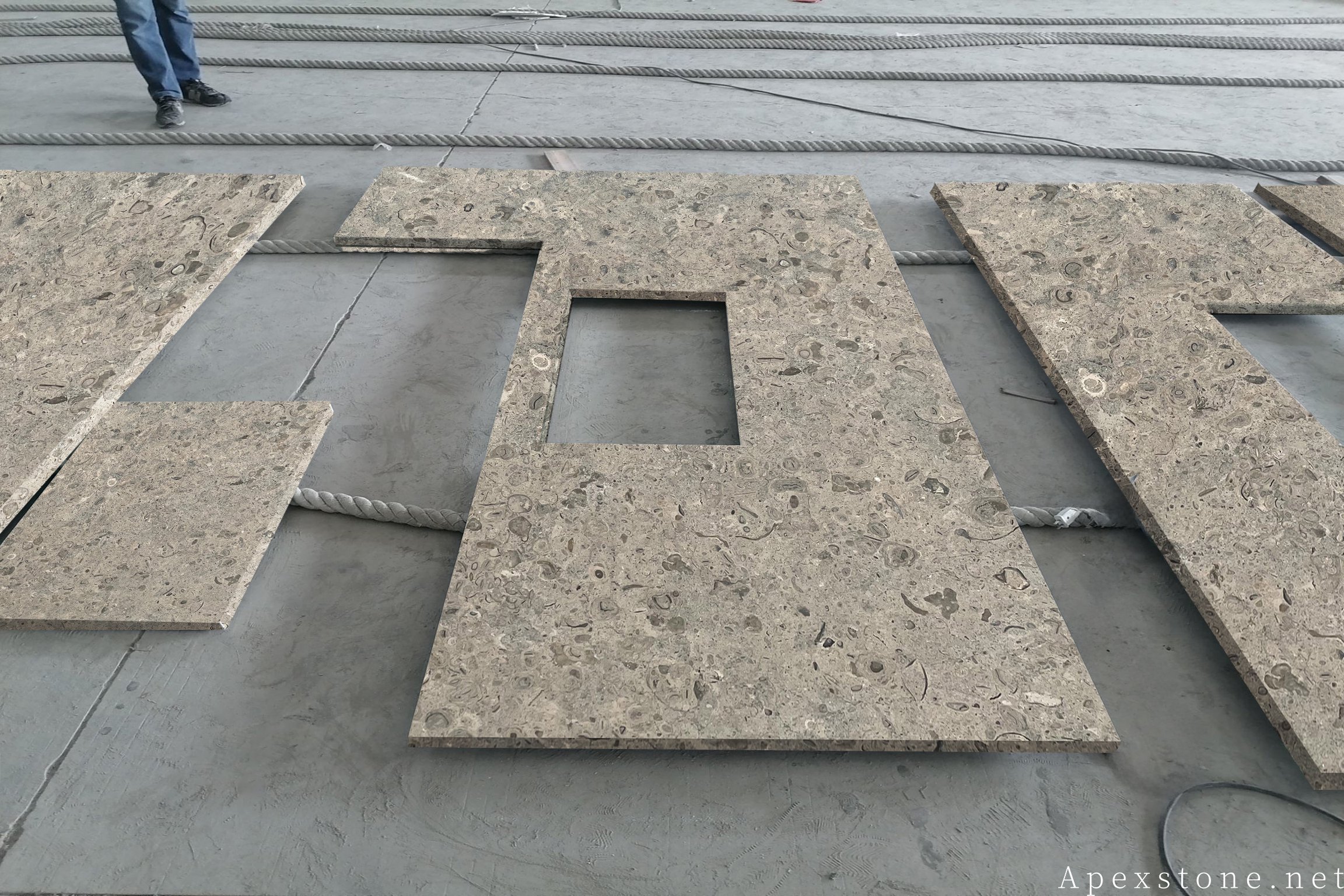
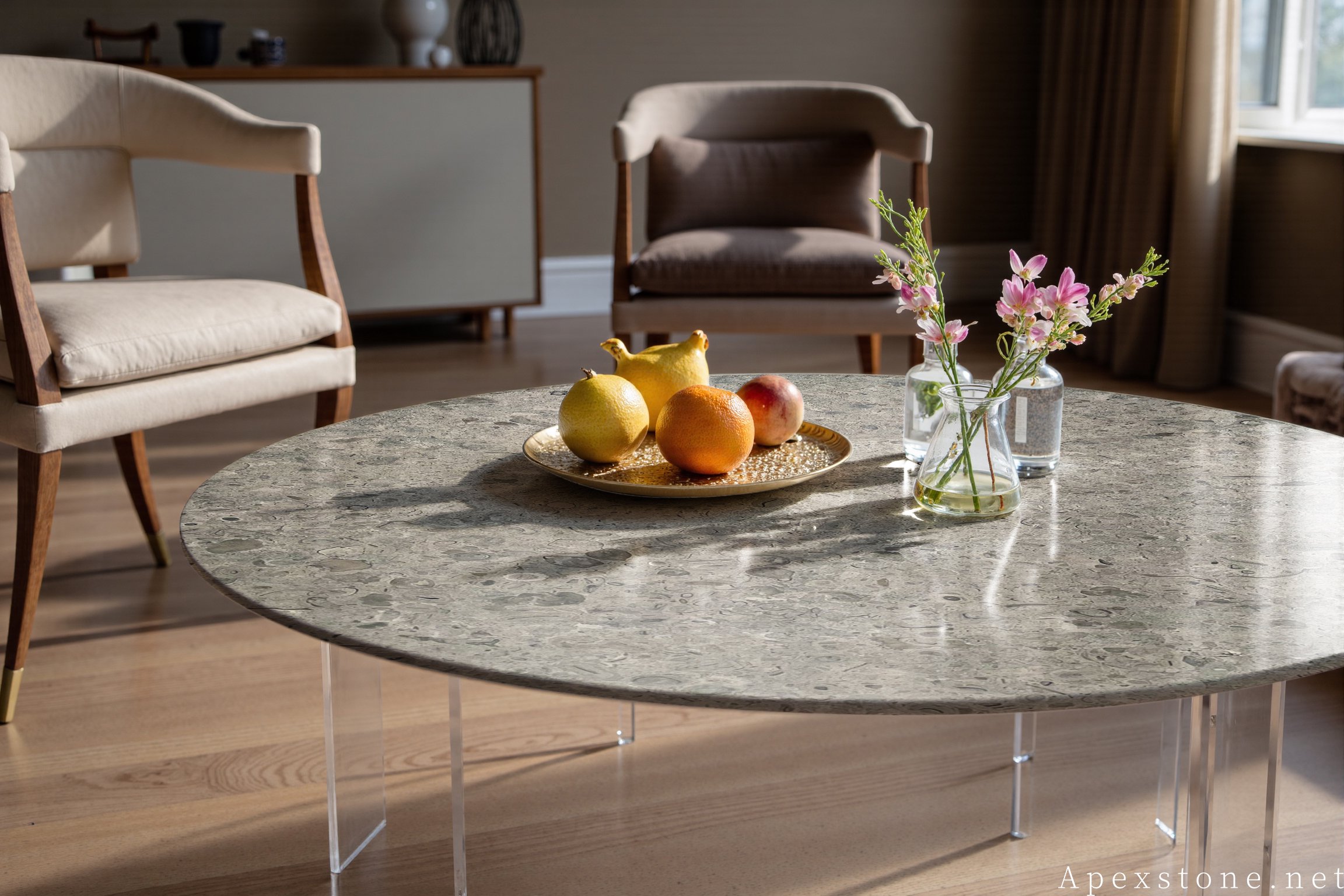
A cultured marble vanity top is a composite casting. Marble dust — fine stone particles — is combined with a resin binder, and the mix is poured into a mold shaped like the finished top. Because the mold carries the bowl, backsplash and edge profile, these features come out of the casting process as part of the piece rather than being added afterward.
That production method explains three properties buyers notice first:
- Uniform pattern. The surface appearance is controlled by how the mix is prepared and poured, so panels made to the same specification look alike.
- Integral bowls and edges. The bowl is part of the casting. There is no joint between bowl and deck where a separate undermount sink would meet the countertop.
- Repeatability. Once a mold exists, additional units follow the same geometry, which suits multi-unit projects such as apartment buildings or hotel refurbishments.
What it is not: a slab. Cultured marble has no cut-stone surface and no natural veining in the geological sense. The pattern is a designed effect. Buyers who want a specific stone look — Calacatta White, for instance — are looking for a different product category, and the specification should say so plainly.
How natural stone vanity tops are made
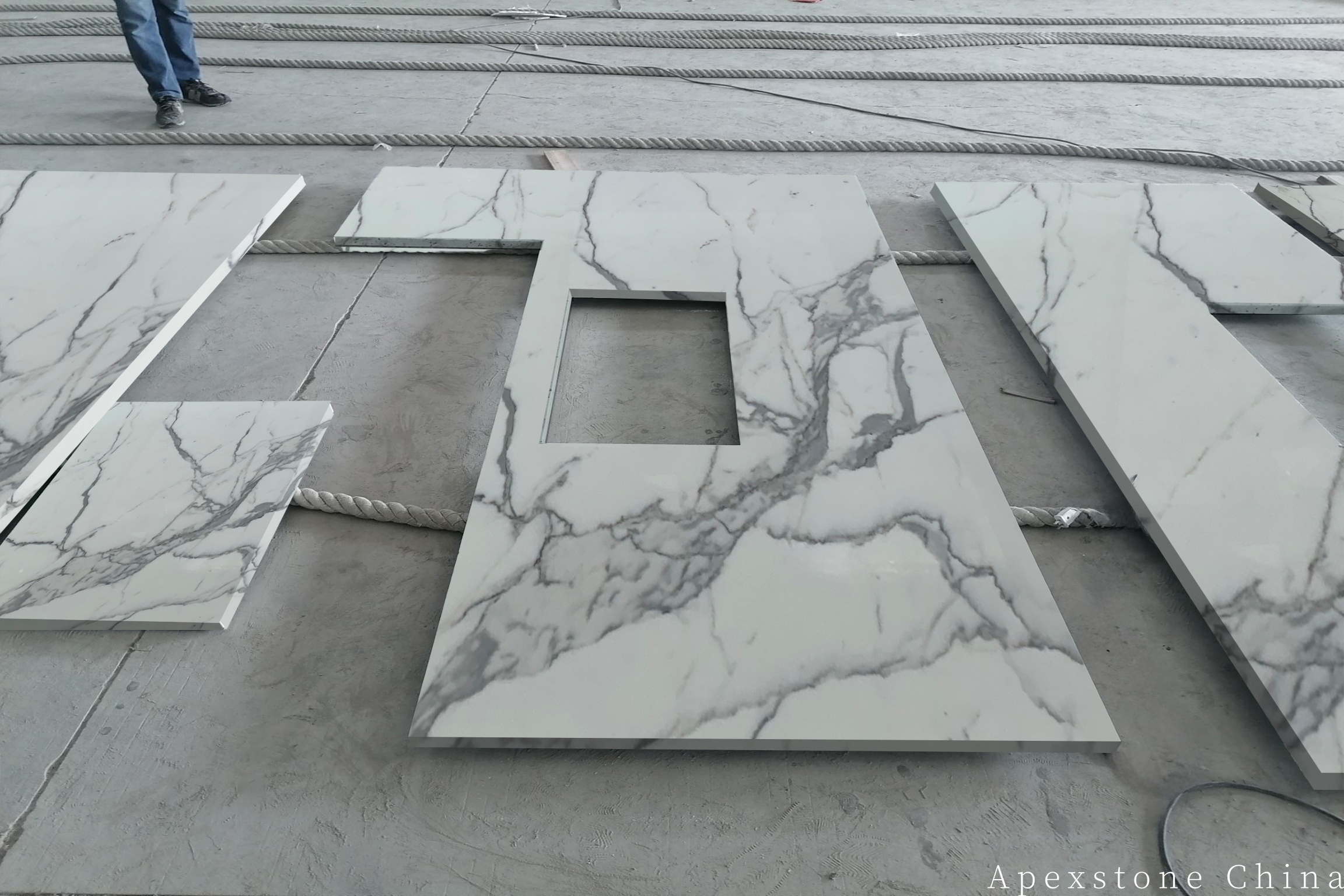
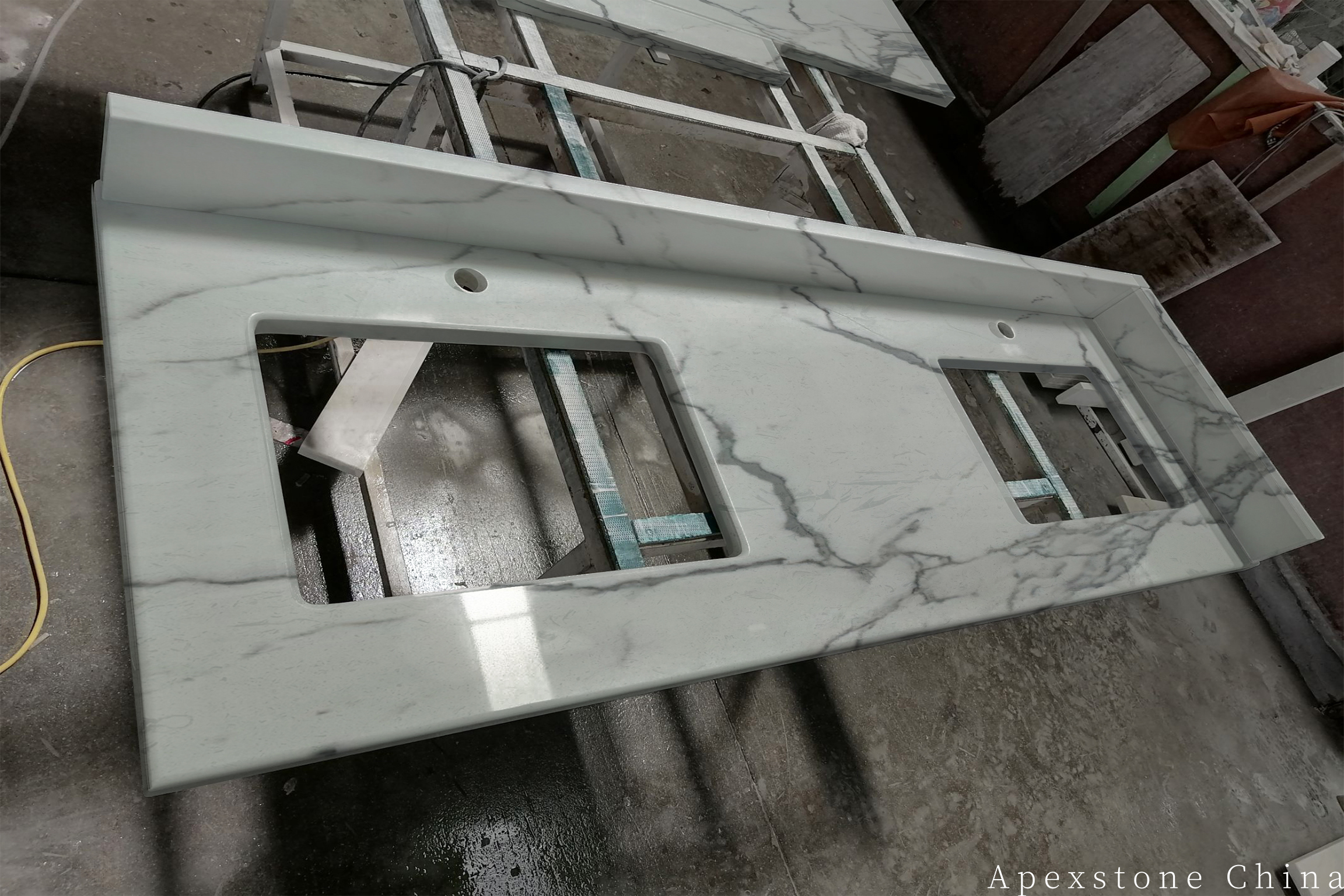
A natural marble vanity top begins as a slab cut from a block. The slab is then machined: sink cutouts and faucet holes are produced on CNC equipment from approved drawings. Depth, edge profile and hole positions are set by the drawing, not by a mold.
For a reference point on how a natural stone line is typically organized, Calacatta White marble vanity tops are cut in single-bowl widths of 25.5, 31 and 37 inch and double-bowl widths of 60 and 72 inch, at a depth of 21–22 inch, in thicknesses of 20 mm (3/4 in) or 30 mm (1-1/4 in). Those sizes are machined to the drawing for each order.
That is the structural difference in one sentence: a cultured top inherits its shape from a mold, while a natural top inherits its shape from a cutting program.
Side-by-side comparison
The comparison below is organized by the decisions a buyer actually has to make. It is not a ranking. Each column has conditions under which it is the sensible choice.
| Decision point | Cultured marble vanity top | Natural stone vanity top (e.g. Calacatta White marble) |
|---|---|---|
| How the shape is formed | Cast in a mold; bowl and backsplash integral to the piece | CNC-machined from slab; sink cutout and faucet drilling from approved drawings |
| Pattern | Uniform by design; repeatable across units | One-of-a-kind veining; each slab differs |
| Geometry limits | Any shape the mold allows, including non-rectangular decks | Bound by slab dimensions and the cutting program; edge and cutout placement must fit the slab |
| Match across multiple units | Same mold and mix specification gives consistent sets | Veining continuity depends on slab selection and how many pieces come from the same block |
| Typical thickness reference | Set by the casting | 20 mm (3/4 in) or 30 mm (1-1/4 in) |
| Approval workflow | Mold and color sample | Drawing approval before machining; slab selection for veining |
Consistency versus one-of-a-kind veining
If a project needs forty bathroom vanities that read as a matched set, cultured marble's uniform pattern does the job without slab-matching work. If the design intent is that no two bathrooms look identical, natural stone delivers something a composite cannot: veining formed by the geology of the block, which no mold reproduces.
The trade-off is in the paperwork as much as the material. Natural stone projects usually involve slab selection and a drawing approval step before machining, because the cutout position has to sit sensibly relative to the veining and the slab edges. Cultured marble projects center on approving a mold and a color sample. Neither workflow is simpler in absolute terms; they front-load different decisions.
Moldability versus CNC-cut slabs
Casting allows shapes that slab cutting makes expensive or impractical — for example, a deck that curves with an integral bowl of the same piece. The mold is the constraint: what exists in tooling is what can be produced, and a new shape means new tooling.
CNC machining inverts that constraint. A natural stone top can be cut to a drawing within the limits of the slab, so the dimensions are flexible in a different way — but every cutout must fit inside the actual slab, and each order is a machining job rather than a repeat cast. For standard single-bowl widths such as 25.5, 31 and 37 inch, or double-bowl 60 and 72 inch at 21–22 inch depth, the machining approach is well suited to defined, drawing-driven production.
How each one ages
Both surfaces are finished materials that respond to what happens in the bathroom, but the wear mechanisms differ.
- Cultured marble wears as a resin-based composite. Its gel-coat surface can be affected by abrasive cleaners and by prolonged contact with very hot objects, which is why care instructions matter more than the material name. Chips at edges are generally repairable by a specialist working with matching material.
- Natural marble is a porous stone. It is typically sealed, and sealing is a maintenance item that recurs. Acidic substances can etch a polished marble surface, and the etch is a change to the stone itself rather than a coating defect. Chips and cracks are handled by a stone fabricator.
The honest summary: neither is maintenance-free. The question is which maintenance regime fits the building and the people who will clean it. For a rental property with a maintenance contractor, that answer may differ from a private residence where the owner controls the cleaning products. Where longevity, repairability or cleaning regime is a hard requirement, ask the supplier what care and repair support is documented for the specific product — generic claims about durability do not answer it.
How to choose by priority
Rather than asking which material is better, rank your project's priorities and let the ranking decide.
- If matched appearance across many units is the priority, a cast composite is the straightforward route; the pattern is specified, not selected slab by slab.
- If the stone look and unique veining are the priority, specify natural stone and plan for slab selection plus drawing approval before machining.
- If an unusual deck shape with an integral bowl is the priority, check what tooling exists before committing to a composite design.
- If a defined size and thickness set must be met, natural stone machined to drawings covers standard vanity widths at 20 mm or 30 mm thickness, as in the Calacatta White marble bathroom vanity tops range.
- If the cleaning regime is unknown, settle that before choosing. It affects the material more than most aesthetic preferences do.
Frequently asked questions
Is a cultured marble vanity top real marble?
No. It contains marble dust as a filler in a resin binder and is cast in a mold. The stone content is real, but the finished top is a composite, not a cut slab. Describing it as a composite is accurate and avoids confusion during specification.
Can a cultured marble top be repaired if it chips?
Composite surfaces are generally repairable by a specialist using matching material, though the result depends on the chip location and the finish. Ask the supplier what repair guidance they provide for the specific product rather than assuming.
Does natural marble need sealing?
Polished marble is porous and is typically sealed, with resealing as recurring maintenance. The interval depends on the stone and how the bathroom is used; follow the supplier's care instructions for the specific slab.
Which is better for a hotel refurbishment?
It depends on whether matched appearance or individual character matters more. A refurbishment that needs consistent bathroom sets leans toward a cast composite; one where each room should feel distinct leans toward natural stone with slab selection built into the schedule.
To compare a natural stone option against a composite quote, start with the drawing: overall width, depth, thickness, bowl count and faucet hole positions. Those are the inputs that determine what can be machined from Calacatta White marble and what has to be cast.