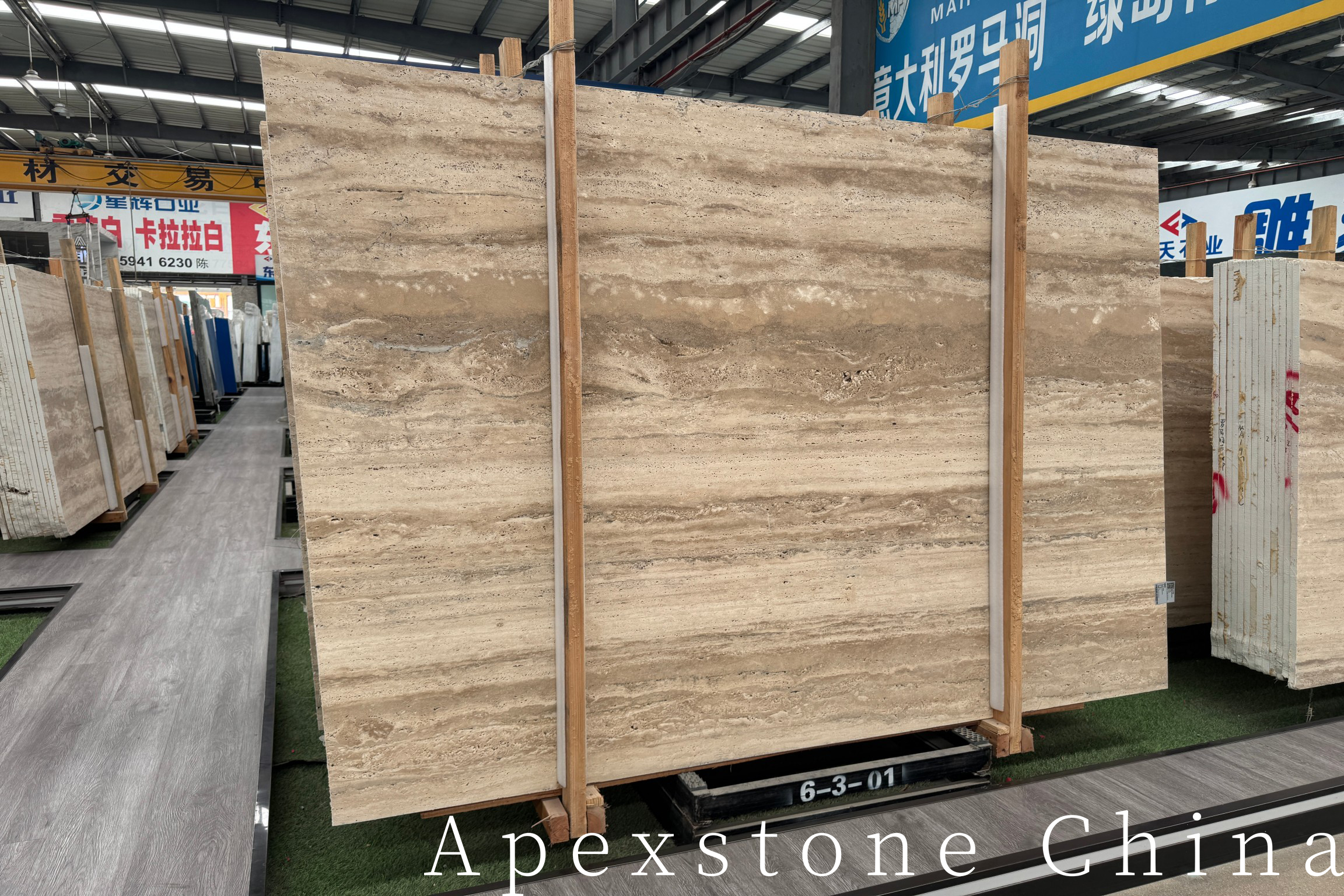
Travertine tile is a calcium-carbonate stone deposited by mineral springs, and its trapped gases create the pores and voids that shape how the material absorbs water, reacts to acids, and gets filled or left open. This explainer connects that origin to the properties buyers test and the documented technical profile of Classico Roma travertine quarried in Lazio, Italy.
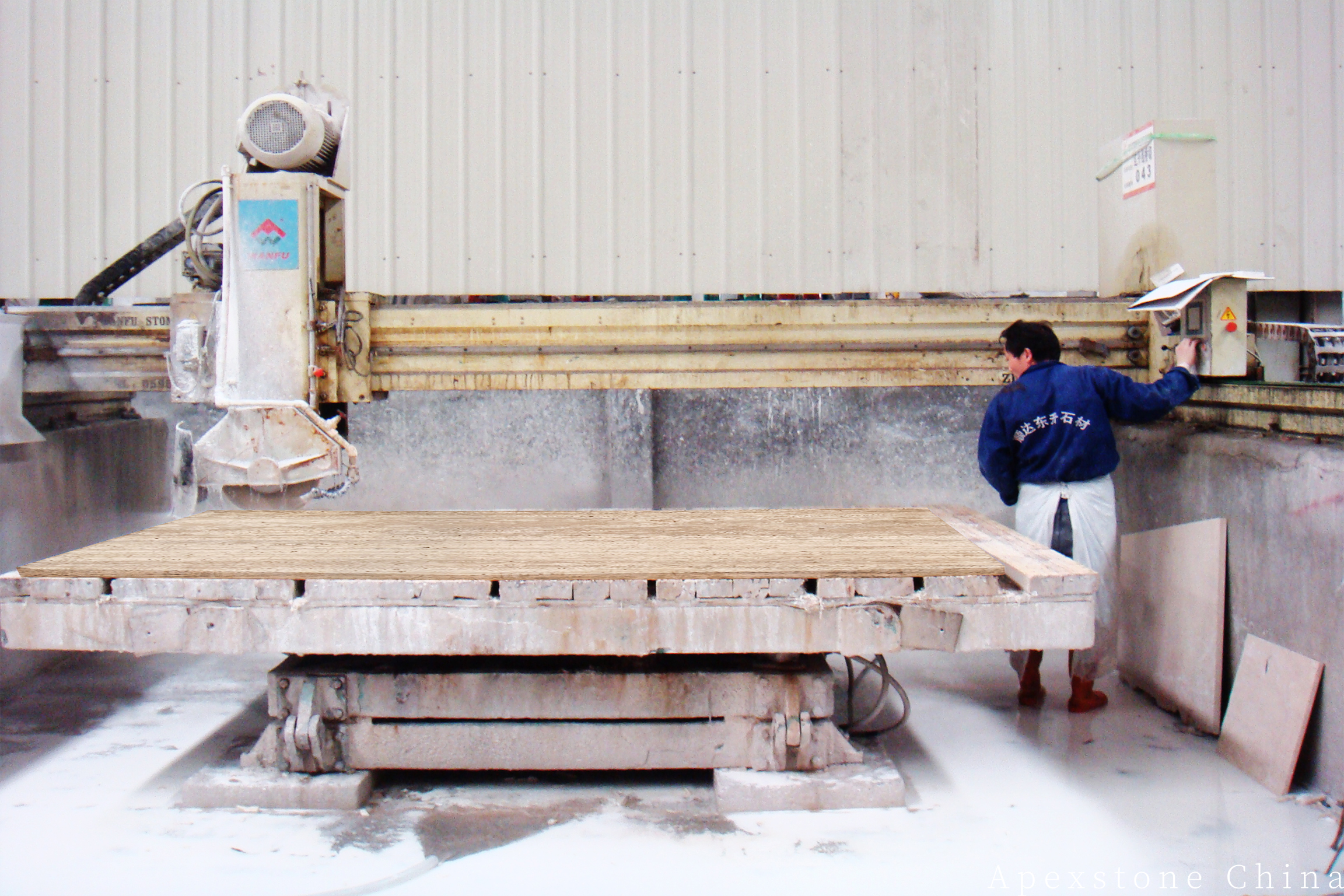
Material Explainer
Travertine tile is a natural stone tile cut from travertine, a form of calcium carbonate deposited by mineral springs. Its defining features—warm beige tones, visible pores, and voids—come directly from how the stone formed. Those same features explain nearly every practical question buyers ask: why it absorbs water, why acidic cleaners etch it, and why some tiles are filled while others are left open. This article follows the material from deposition to the saw line and connects that chain to the technical profile of Classico Roma travertine quarried in Lazio, Italy.
What this article covers
How mineral springs build a stone
Travertine forms when calcium-rich water reaches the surface and releases carbon dioxide. As the gas escapes, dissolved calcium carbonate becomes insoluble and precipitates. Over time, this precipitate accumulates in layers around springs, in shallow pools, or along stream beds. The result is a banded, relatively soft stone with a characteristic open structure.
The Classico Roma variety is quarried in the Lazio region of Italy. Its warm beige background reflects the particular chemistry and depositional environment of those springs, but the fundamental process is the same one that gives all travertine its porosity.
The key point for buyers is that travertine is not a metamorphic marble or a dense limestone. It is a spring-deposited carbonate with a structure that includes voids from the start. That origin shapes everything that follows.
Why pores and voids are part of the material
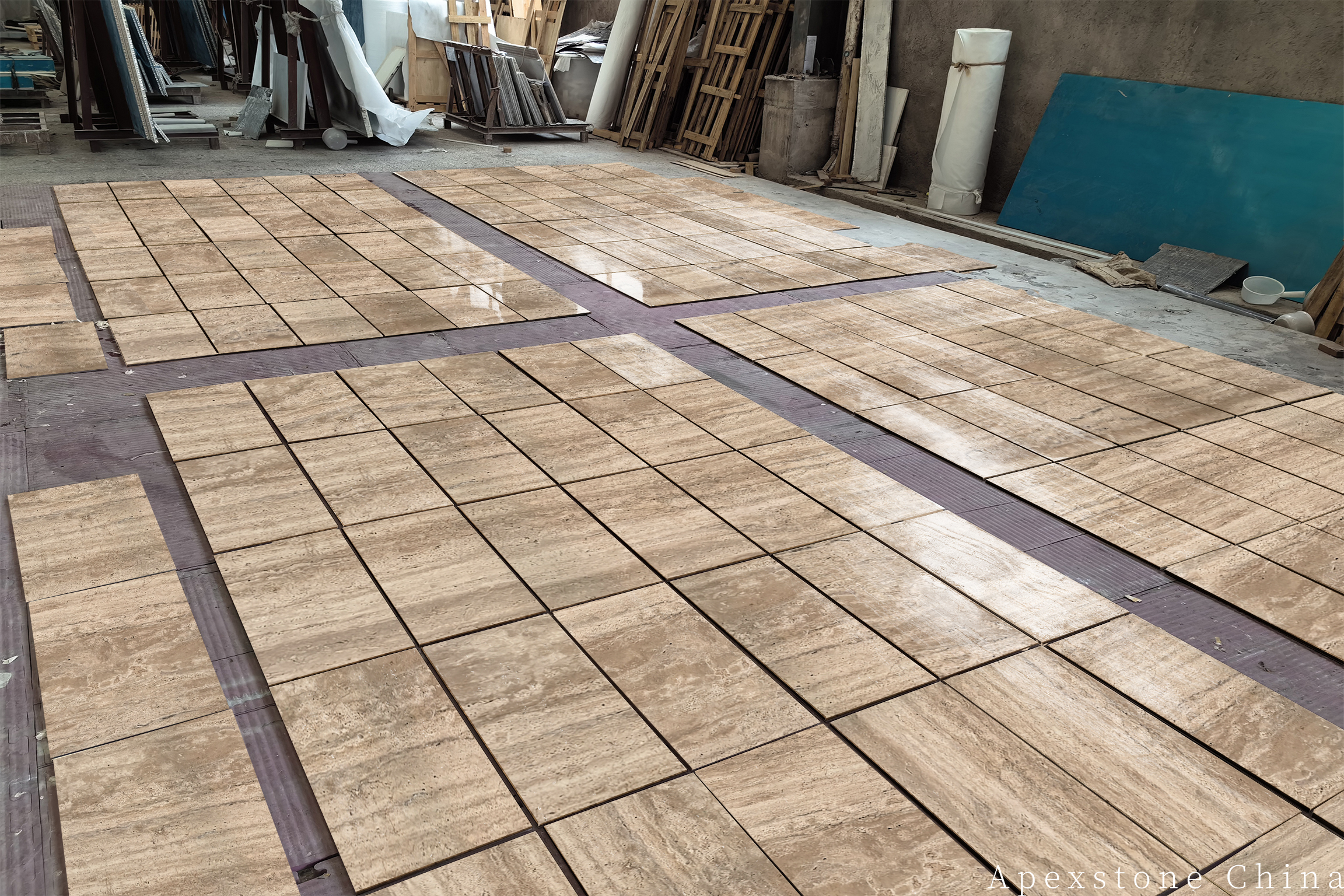
As the calcium carbonate layers build up, trapped gases and organic material create irregular cavities. Some pores are small and evenly distributed; others are larger voids that can run several centimetres across. In the quarry, these features are visible on the face of the block. On the saw line, they become the reason travertine cannot be treated like a homogeneous tile.
The pores are not defects in the sense of a manufacturing flaw. They are inherent to the depositional process. However, their size, distribution, and density vary from block to block and even within a single slab. That variability is why travertine is often graded—and why surface treatment matters.
Buyer takeaway: When you evaluate travertine tile, you are evaluating a material with a natural void structure. The question is not whether pores exist, but how they are addressed for your application.
From composition to practical behaviour
The calcium carbonate composition and the porous structure together explain the properties buyers test and ask about.
Why travertine absorbs water
Water absorption in travertine typically ranges from 1% to 3% by weight. This is higher than dense granite or porcelain, because the open pores provide pathways for moisture. The absorption value depends on the pore structure of the specific tile. For flooring in wet areas or exterior cladding, this absorption is a design consideration. Filling reduces surface absorption, but it does not eliminate the stone's inherent porosity.
Why acids etch travertine
Calcium carbonate reacts with acids. When acidic liquids—citrus juice, vinegar, some cleaning agents—contact the surface, they dissolve a small amount of the carbonate, leaving a dull mark. This is a chemical reaction, not a coating failure. It is why neutral cleaners are recommended for travertine. The same reactivity is part of what makes travertine a genuine carbonate stone rather than a look-alike.
Why hardness and strength matter
Travertine falls in the 4–5 range on the Mohs hardness scale, which is softer than granite but suitable for many interior applications. Compressive strength typically falls between 60 and 120 MPa, a range that supports use in flooring, wall cladding, and other structural applications where the stone is properly supported. These values reflect the stone's carbonate composition and its degree of porosity.
Documented technical profile
The following table summarises the key technical values for Classico Roma travertine. These are reference figures; actual values can vary by block and finish.
| Property | Value |
|---|---|
| Density | 2.3–2.7 g/cm³ |
| Water absorption | 1–3% |
| Mohs hardness | 4–5 |
| Compressive strength | 60–120 MPa |
| Slab dimensions | Up to 3000 x 1800 mm (118 x 71 inch) |
| Reference thickness | 18 mm, 20 mm, or 30 mm |
These values are consistent with travertine's origin: a carbonate stone with moderate density and measurable porosity. The density range reflects variations in pore volume. The absorption range is a direct consequence of the open structure. The hardness and strength values indicate a stone that can be used in many building applications but is not in the same class as harder igneous stones.
Filled or unfilled: a choice tied to application
Travertine tile is available in filled and unfilled surface options. The choice is not about quality—it is about matching the surface to the application.
Unfilled travertine retains the open pores and voids. It offers a more rustic, textured appearance. Unfilled surfaces are common in exterior paving, wall cladding, and decorative applications where the natural open structure is desired. However, the open pores can trap dirt and hold moisture, so sealing is often considered.
Filled travertine has the pores filled with a cement-based or resin filler that is matched to the stone colour. Filling creates a smoother surface that is easier to clean and less prone to dirt accumulation. It is common for interior flooring, countertops, and other applications where a more uniform surface is preferred. Filling does not change the stone's composition, but it reduces surface absorption and improves cleanability.
Both options are valid. The decision should be based on where the tile will be installed, the expected traffic, and the desired aesthetic.
A/B grading and what it signals
Travertine is often graded based on background tone and pore density. A/B grading is a common trade practice. 'A' grade typically indicates a more uniform background tone with fewer large voids, while 'B' grade may show more variation in tone and pore structure. Grading helps buyers specify the visual consistency they need for a project. It is not a measure of structural performance, but it does relate to the stone's natural variability.
For projects where a consistent appearance is important, specifying a grade helps align expectations. For applications where natural variation is acceptable or desired, a lower grade may be suitable.
FAQ
Is travertine a type of marble?
Travertine and marble are both calcium carbonate stones, but they form differently. Marble is metamorphic, while travertine is sedimentary and deposited by springs. The porous structure of travertine distinguishes it from typical marble.
Can travertine tile be used outdoors?
Yes, travertine is used outdoors, particularly in paving and cladding. Its porosity and freeze-thaw behaviour should be considered. In colder climates, proper installation and sealing are important. The technical profile supports outdoor use when the application is designed for the stone's characteristics.
How do I clean travertine?
Use a neutral pH cleaner. Avoid acidic cleaners, which can etch the surface. For filled travertine, regular sweeping and damp mopping are usually sufficient. Unfilled travertine may require more frequent cleaning of the pores.
Does filling affect the stone's strength?
Filling is a surface treatment. It does not significantly change the compressive strength of the stone. It primarily affects surface properties such as cleanability and resistance to dirt accumulation.
Next step
If you are evaluating travertine for a project, the origin and structure of the stone give you a framework for the questions to ask. For a closer look at the Classico Roma slabs discussed here, see the product page: Classico Roma Italian Travertine Slab.