Travertine tile is a natural stone cut from mineral-spring deposits, defined by its voids and linear grain. This explainer follows the stone from formation in Lazio, Italy, to the finish and thickness choices that decide where it belongs indoors and outdoors, and how it behaves differently from marble and limestone.
Natural Stone Explainer
What Is Travertine Tile?
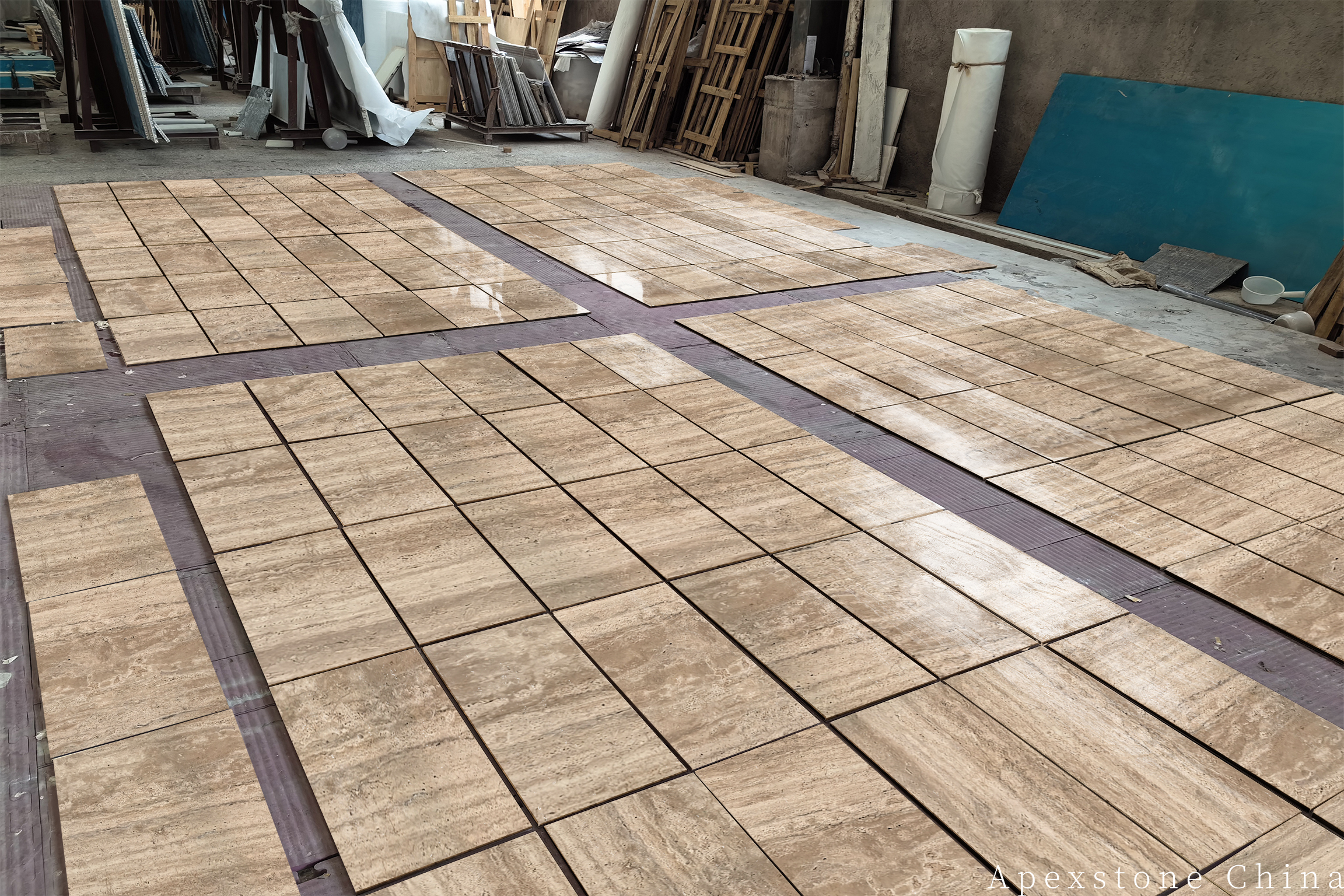
Travertine tile is a natural stone tile cut from travertine, a sedimentary rock deposited by mineral-rich springs. The stone is quarried in Lazio, Italy, where the Classico Roma variety is known for its warm beige color, natural voids, and linear grain. Those voids are not defects; they are the signature of how the stone formed, and they explain much of how it behaves as a finished tile.
Key Takeaways
- Travertine is a spring-deposited stone, not a metamorphic marble or a dense sedimentary limestone.
- Its natural voids and linear grain are visible in every slab and tile, though finishes and filling change how the surface reads.
- Density of 2.3–2.7 g/cm³, water absorption of 1–3%, Mohs hardness of 4–5, and compressive strength of 60–120 MPa place it in a distinct working range.
- Indoor tiles commonly come in 600x600 mm and 800x800 mm formats, with 10 mm for walls, 18 mm for floors, and 20 mm for heavy-duty floors.
- Outdoor use depends on matching thickness to duty: 20 mm paving, 30 mm pool coping, 40 mm driveway.
In this article
From Mineral Spring to Stone
Travertine forms at the surface, not deep underground. Calcium-rich water emerges from springs, and as it flows and degasses, calcium carbonate precipitates onto the ground, plants, and debris in the path. Layer builds on layer, sometimes quickly enough to entomb leaves and stems. The result is a banded stone with a linear grain and a network of pores where gas escaped or where soft organic material later decayed.
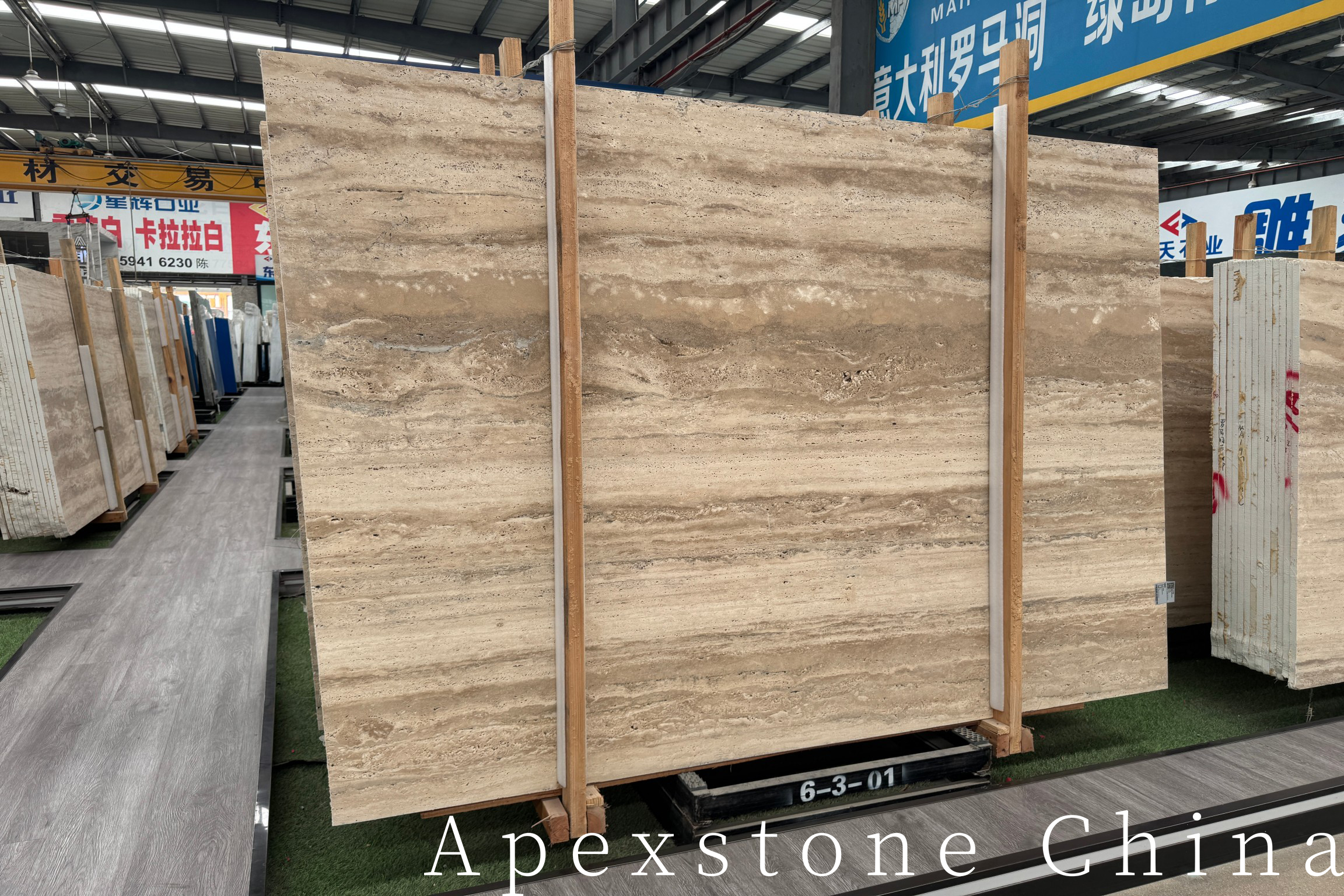
The Classico Roma material quarried in Lazio, Italy, is a reference point for this look: a warm beige ground with darker linear movement and visible voids that run through the body of the stone, not just the surface. When a block is sawn into slabs or tiles, those features appear across every cut. That is why travertine tile has a directional visual character that differs from a uniformly speckled stone.
The voids also shape the manufacturing sequence. A block is sawn, then the surface is either left open or filled with a cementitious or resin-based filler, then honed, polished, brushed, or tumbled. The choice of finish is not cosmetic alone; it determines how much of the pore structure remains exposed and how the tile will be cleaned and maintained.
How the Voids Are Treated: Four Finishes
Travertine tile is commonly supplied in four finish families, and each suits a different setting.
- Filled honed: The voids are filled and the surface is ground to a smooth, matte finish. The linear grain remains visible, but the surface is closed and relatively easy to wipe. This is the typical choice for interior floors and wall cladding where a calm, even surface is wanted.
- Filled polished: Same filled body, brought to a higher sheen. It reflects light more strongly and reads as a more formal surface. Polished travertine is usually reserved for interior floors and feature walls where slip resistance is not the primary concern.
- Unfilled brushed: The voids are left open and the surface is brushed to a textured, matte finish. The stone feels and looks more raw. Brushed unfilled travertine is often used where a grippier surface and a natural appearance matter more than a sealed, uniform face.
- Unfilled tumbled: The edges and face are tumbled to soften corners and open the texture further. Tumbled travertine has a worn, rustic character and is commonly specified for outdoor paving and pool surrounds, where a broken-in look and a textured surface are acceptable or desired.
None of these finishes changes the stone itself. They change how much of the pore structure stays open and how the surface behaves underfoot and under a mop.
The Numbers That Guide Placement
Travertine sits between the denser stones and the more porous ones. The figures below are typical working values for the material and are the numbers to use when comparing it with marble, limestone, or a porcelain lookalike.
| Property | Typical value | What it means in practice |
|---|---|---|
| Density | 2.3–2.7 g/cm³ | Lighter than dense marble; weight matters for wall fixing and shipping calculations. |
| Water absorption | 1–3% | Moderate porosity; sealing is part of the specification, not an optional extra. |
| Mohs hardness | 4–5 | Softer than granite and harder than most talc-based stones; abrasion and acids need attention. |
| Compressive strength | 60–120 MPa | Sufficient for flooring and cladding when thickness and bedding are matched to the load. |
Thickness is the other half of the specification. Indoor travertine tiles are commonly supplied in 600x600 mm and 800x800 mm formats, with 10 mm for wall applications, 18 mm for floors, and 20 mm for heavy-duty floors. Outdoor formats are typically 600x600 mm (24x24 inch) or a French Pattern, with thickness matched to duty: 20 mm for paving, 30 mm for pool coping, and 40 mm for driveways.
Where Travertine Tile Works Indoors
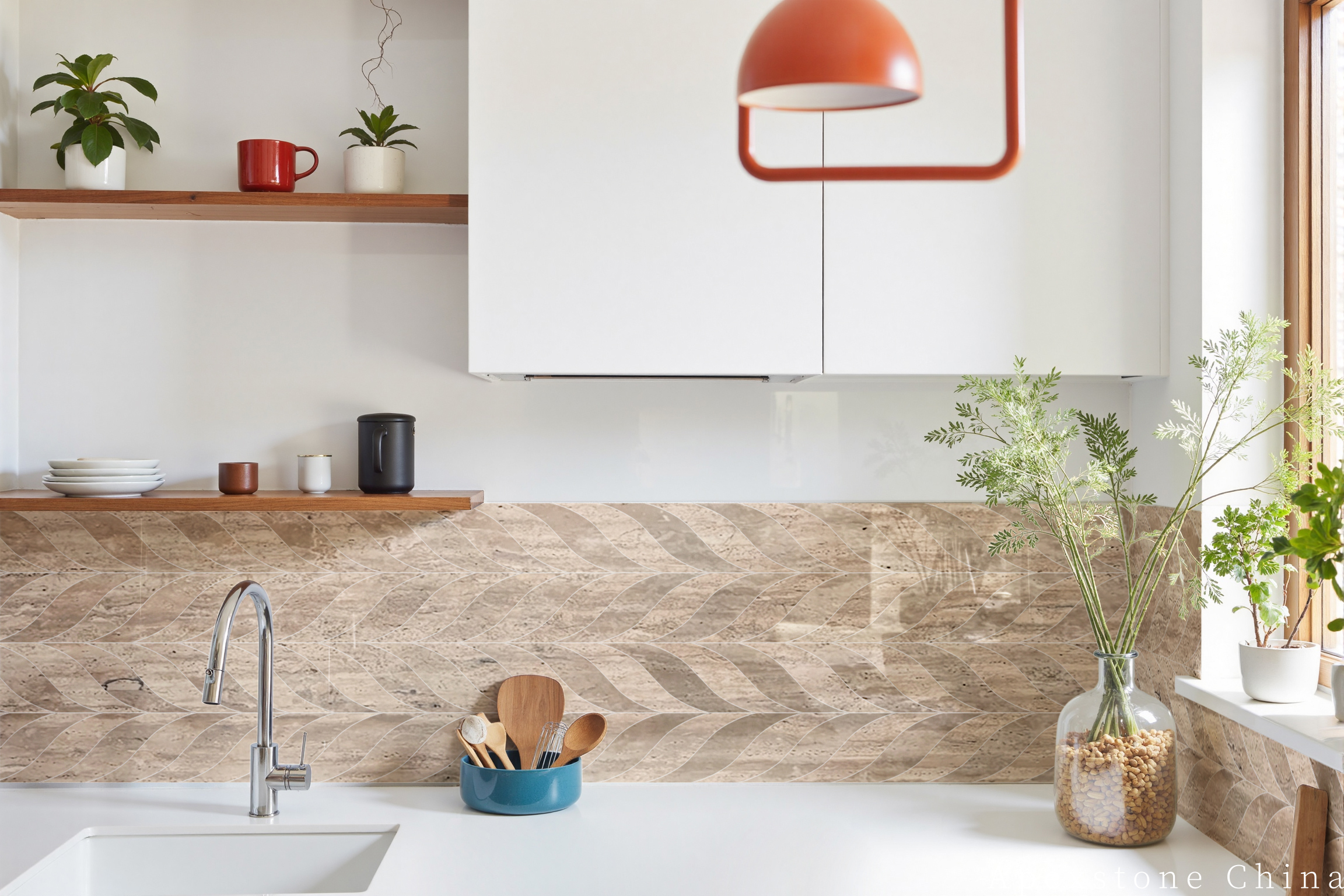
Indoors, filled honed and filled polished travertine are the most straightforward choices. The closed surface handles everyday cleaning, and the warm beige tone and linear grain suit floors, bathroom walls, fireplace surrounds, and feature walls. The 600x600 mm and 800x800 mm formats cover most residential and light-commercial floor plans without excessive cutting.
Two indoor decisions matter more than the look. First, the thickness: 10 mm is a wall tile, 18 mm is a floor tile, and 20 mm is for floors that will see heavier traffic or point loads. Second, the finish: a polished surface in a wet area such as a bathroom floor is a slip consideration, while a honed or brushed surface offers more texture. In wet rooms, sealing is part of the installation specification because the water absorption range of 1–3% means the stone will take up some moisture if left unprotected.
Unfilled brushed travertine can also be used indoors, but it brings open pores into the interior. That is a deliberate choice for a textured wall or a rustic floor, not a default for a low-maintenance bathroom.
Where Travertine Tile Works Outdoors
Outdoors, travertine tile is usually specified in thicker formats and more textured finishes. The 20 mm paving thickness suits terraces, garden paths, and patio areas. Pool coping is commonly 30 mm, and driveways 40 mm, because the thicker section carries the load and resists point pressure. The 600x600 mm (24x24 inch) format and the French Pattern are the usual outdoor layouts; the French Pattern mixes several sizes in one repeating set, which reduces visible repetition across a large paved area.
Unfilled brushed and unfilled tumbled surfaces are common outdoors because the open texture provides grip and the tumbled edges soften the joints. Travertine is often chosen around pools and terraces, and its light, textured outdoor surfaces are generally described as staying cool underfoot in sunlight — a qualitative observation rather than a performance guarantee. The actual feel underfoot still depends on the stone's color, surface finish, thickness, and how long the area sits in the sun, so it is worth checking in the specific project setting. Frost resistance depends on proper sealing and installation; the stone is not automatically frost-proof in every climate. Before specifying for a cold region, check the tile's water absorption, confirm that the sealer is rated for freeze-thaw conditions, and review the bedding and drainage detail with the installer; the supplier should confirm suitability for the project location.
How It Differs from Marble and Limestone
The difference is behavioral, not just visual. Marble is a metamorphic stone formed under heat and pressure; it is generally denser and can take a higher polish, but it is also sensitive to acids and can etch. Limestone is a sedimentary stone formed largely from shell and skeletal debris; it is typically more uniform and can be more porous or softer depending on the bed. Travertine is a spring deposit with a directional grain and a void structure that neither marble nor limestone shares in the same way.
| Behavior | Travertine | Marble | Limestone |
|---|---|---|---|
| Formation | Spring-deposited calcium carbonate | Metamorphic | Sedimentary, often fossil-bearing |
| Visual signature | Warm beige, linear grain, visible voids | Veined or clouded, takes a high polish | Uniform to fossil-flecked, generally even |
| Water absorption | 1–3% typical | Generally lower and more variable by type | Variable, often higher in porous beds |
| Acid sensitivity | Calcium carbonate; acids attack the surface | Calcium carbonate; acids etch | Calcium carbonate; acids attack |
| Best indoor use | Filled honed or polished floors and walls | Feature floors, walls, and vanities | Floors and walls where an even surface is wanted |
| Best outdoor use | Paving, pool coping, driveways in thicker sections | Selected cladding and paving with care | Paving and walling where the bed is suitable |
A practical consequence: if the design calls for a very high-gloss reflective floor, marble is the more natural fit. If the design calls for a warm, textured surface with visible pore structure and a grippier feel, travertine is the better match. If the design calls for a quiet, uniform field, limestone is often the simpler choice.
For projects specifying Italian travertine, the Roman Classico range is available as travertine Romano tiles for floor and wall and as Romano slabs in Classico Roma. Format, finish, and thickness should be matched to the indoor or outdoor duty described above.
FAQ
Is travertine tile the same as marble?
No. Travertine is a spring-deposited sedimentary stone with visible voids and a linear grain; marble is metamorphic and generally denser and more uniform in its veining. They share calcium carbonate chemistry but differ in formation and working behavior.
Can travertine tile be used in a bathroom?
Yes, with the right finish and sealing. Filled honed travertine is a common bathroom wall and floor choice; polished travertine on a wet floor should be assessed for slip, and sealing is part of the installation specification given the 1–3% water absorption range.
Does travertine tile need to be sealed?
Sealing is normally specified to limit moisture uptake and to help with stain resistance, particularly for outdoor paving and wet areas. Frost resistance also depends on proper sealing and installation, so the sealer and bedding should be confirmed for the project climate.
What thickness should I use outdoors?
Match thickness to duty: 20 mm for paving, 30 mm for pool coping, and 40 mm for driveways. For indoor work, 10 mm is a wall tile, 18 mm a floor tile, and 20 mm a heavy-duty floor tile.