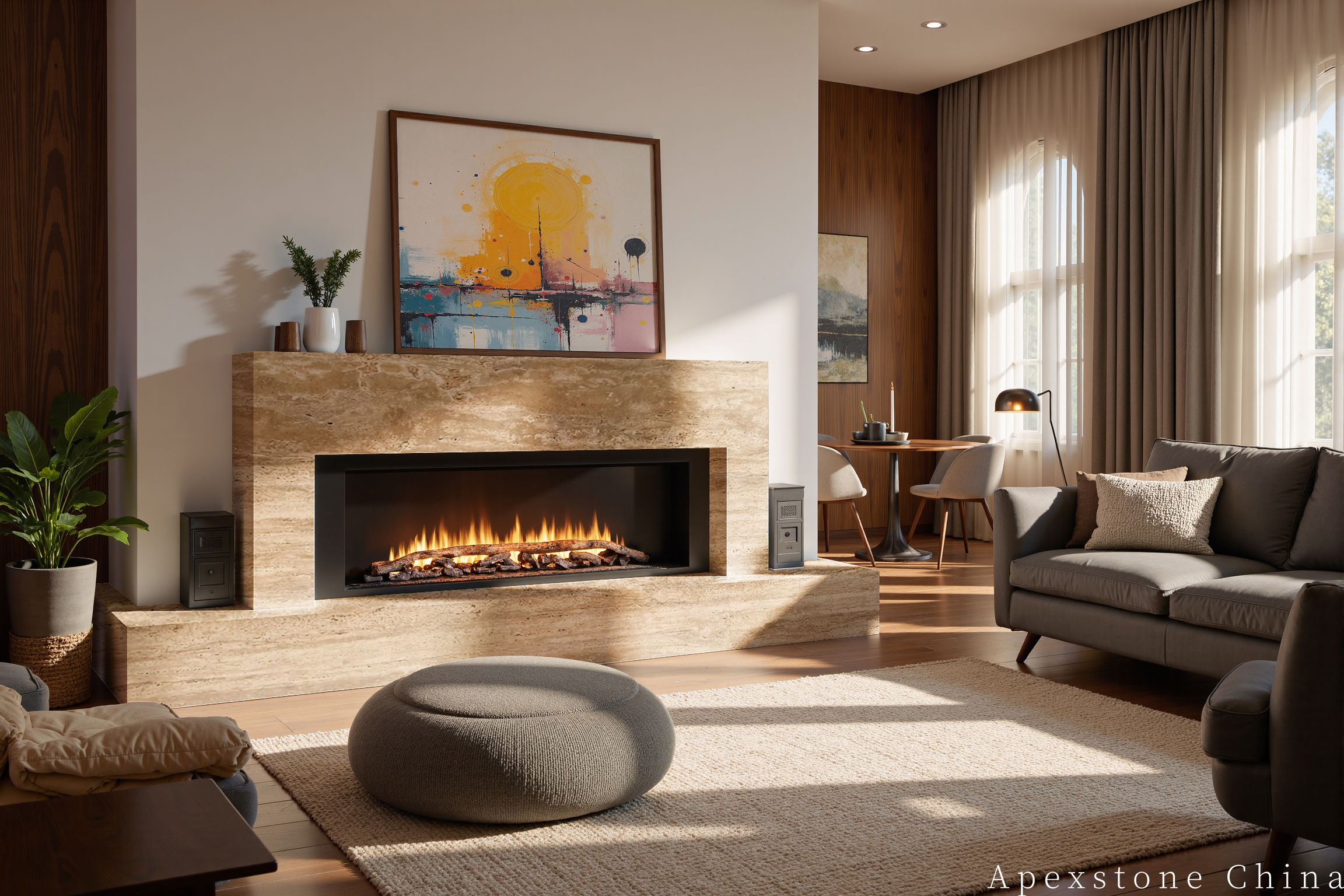
A component-by-component guide to specifying natural stone for a fireplace: what surround panels, hearth slabs, mantel shelves, full-height feature walls and ledger stone each demand, how Italian travertine meets those demands, and where the stone supplier's role ends and the installer's begins.
Stone specification guide
A fireplace is not one stone job. It is five small jobs sitting next to each other: the surround, the hearth, the mantel, the feature wall behind, and — if you want that split, stacked look — a ledger profile. Each part asks something different of the material, and a stone that answers one part well may be the wrong choice for the next.
This guide works through those parts one at a time. For each, it sets out what the stone has to do, which finish and thickness make sense, and how Italian travertine — specifically Travertine Classico Roma, a warm beige stone with natural voids and a classical linear grain — performs in that position.
- Surround panels are thin: 18–20 mm (about ¾ in).
- Hearth slabs are thicker: 30 mm (1-¼ in), for thermal mass and durability.
- Filled honed is the sensible default for a hearth; filled polished for a surround; unfilled brushed when you want the voids to read.
- Clearances to the firebox are set by local building codes and the fireplace type, and confirmed by the installer on site — not by the stone supplier.
Start with the surround: thin panels, tight tolerances
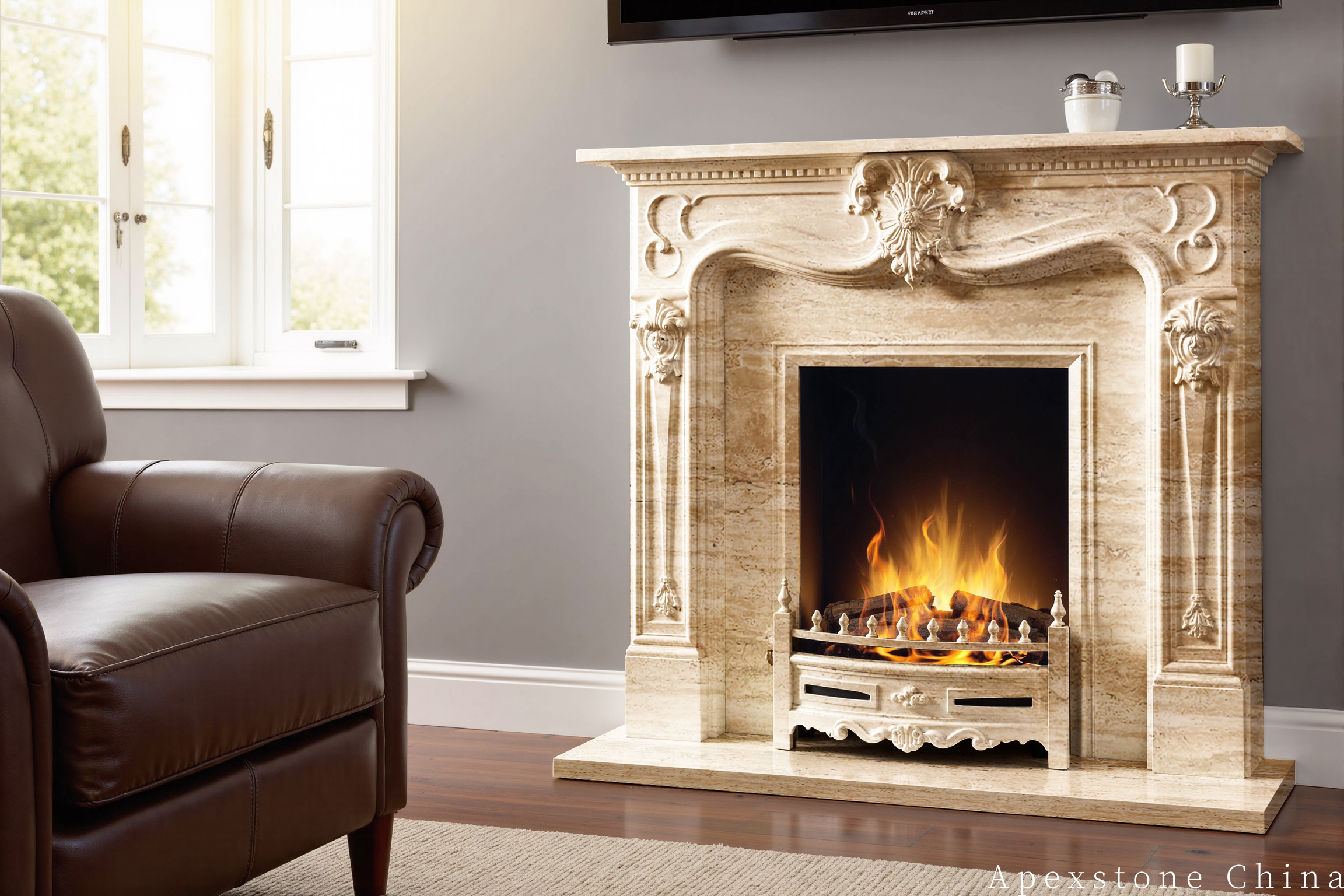
The surround is the visible face around the opening — legs, header, and the returns that frame the firebox. It is a finish element more than a structural one, which is why it is usually specified thin: 18–20 mm (about ¾ in). Thin panels keep the assembly light and let the surround sit close to the wall without building out a deep return.
What the surround asks of the stone:
- Stable grain across panels. Legs on either side of an opening will be read together. Travertine's linear grain runs in one direction, so panels cut from the same block and laid out with the grain continuous avoid the awkward mismatch you get when pieces are pulled at random.
- Heat tolerance at the near edge. Travertine is a solid natural-stone material, which is one reason it is commonly specified around fireplaces. How much heat the near edge actually takes depends on the appliance and the installation, so the installer should confirm clearances on site before the panels are cut.
- A finish that hides handling. Filled polished gives a smooth, reflective face; filled honed is calmer and shows less of the day-to-day marking that a polished surface picks up around a working fireplace.
The supplied product record covers the surround and hearth components together: Travertine Romano fireplace surrounds and hearths.
The hearth: where thickness and thermal mass matter
The hearth is the part that takes the load, the dropped logs, the ash, and the heat radiating down. It is also the part people stand on or set things down on, so it has to resist abrasion as well as heat.
This is why the product record specifies a 30 mm (1-¼ in) hearth slab rather than the 18–20 mm used on the surround. The extra section gives the slab thermal mass — it absorbs and releases heat more steadily than a thin panel — and it gives durability at the exposed front edge, which is the first place a hearth chips if it is under-specified.
Travertine's material record supports the choice: density of 2.3–2.7 g/cm³ and compressive strength of 60–120 MPa. Those figures describe the material itself; whether a slab can span a given hearth opening without flexing depends on the thickness, the support, and the load, so confirm the span with your fabricator.
Finish on a hearth: filled honed. The fills close the natural voids at the walking surface, and the honed face gives a smooth, heat-resistant surface without the slip and shine of a high polish. An unfilled hearth is possible as a style decision, but understand that you are choosing open voids where ash and grit will collect.
The mantel shelf and overmantel: continuity, not a separate purchase
The mantel shelf is the piece people touch most, and the overmantel is what the eye follows upward from the firebox. Both work best when they come from the same stone family as the surround, because grain direction, base tone and fill colour will match across the joint.
A shelf specified from a different lot or a different stone shows up immediately at the mitre. If you are detailing a mantel and an overmantel, keep them in the same order as the surround panels so the fabricator can sequence the cuts.
The full-height feature wall: fewer joints, more continuity
A floor-to-ceiling fireplace wall changes the brief. Now the stone is a wall surface as well as a fire surround, and the dominant visual issue is joints. Every seam interrupts the linear grain.
Large-format panels make a full-height wall possible with joints kept to a minimum — the grain runs from hearth to ceiling as one field instead of being chopped into tile-sized segments. The same material record applies: heat resistance at the lower zone near the firebox, and the density and compressive strength figures above for the panel section. Finish is a whole-wall decision here: honed for a matte, architectural read, polished if the room can carry the reflection.
The wall and floor tile range using the same stone is listed at Italian travertine Romano tiles for floor, wall and backsplash.
The ledger look: a different style, not a different stone
Ledger stone is a split, dimensional stone look — narrow courses of stone face stacked in horizontal bands, giving texture and shadow rather than a smooth plane. It is a visual choice, and it sits at the opposite end of the style scale from a honed panel surround. If you are weighing the two: a honed or polished panel reads classical and calm; a ledger face reads rustic and textured, and it suits a chimney breast or a full-height wall better than a small surround where the coursing would have nowhere to run.
Keep the specification qualitative until the fabricator has confirmed what the block will yield. The stone family is the same; the look is not.
Matching the part to the stone
| Component | Typical thickness | Suggested finish | What it asks of the stone |
|---|---|---|---|
| Surround panels | 18–20 mm (about ¾ in) | Filled polished or filled honed | Grain continuity across legs and header; heat tolerance at the near edge |
| Hearth slab | 30 mm (1-¼ in) | Filled honed | Thermal mass, edge durability, abrasion resistance |
| Mantel shelf / overmantel | Matched to surround | Same as surround | Tone and grain match across mitres |
| Full-height wall | Large-format panels | Honed or polished | Joint minimisation; continuous grain over height |
| Ledger face | Split dimensional profile | Unfilled / split face | Texture and shadow; coursing suited to large planes |
Filled or unfilled: a decision about voids
Travertine's natural voids are part of its character. Filling them gives a closed, consistent surface — the practical choice for a hearth and for any surround you want to wipe down. Leaving them open gives the stone its pitted, quarried look, which is a deliberate style decision and belongs with the ledger and rustic end of the range.
Filled honed, filled polished and unfilled brushed are the three finishes in the record. Brushed unfilled sits between smooth and textured: the surface is worked but the voids remain.
Where the stone specification ends: clearances
One thing this guide will not give you is a clearance figure, and that is deliberate. The distance from the stone to the firebox is a function of two things: local building codes and the type of fireplace being installed. Those are confirmed by the installer on site, with the actual appliance and the actual wall build-up in front of them.
A stone supplier can tell you the thickness, the finish, the density and the compressive strength — the figures quoted above come from the product record. A stone supplier cannot tell you how close the surround may sit to a particular firebox in a particular jurisdiction. Ask the installer to confirm clearances before the surround panels are cut, because the answer may change the panel sizes.
Frequently asked questions
What thickness should a fireplace hearth slab be?
30 mm (1-¼ in) in the product record. The extra thickness over the 18–20 mm surround panels provides thermal mass and durability at the exposed front edge.
What thickness are travertine fireplace surround panels?
18–20 mm (about ¾ in). The surround is a finish element, so thin panels keep the assembly light and avoid a deep build-out from the wall.
Which finish is best for a hearth?
Filled honed. The fill closes the voids at the walking surface and the honed face is smooth and heat-resistant without a high shine.
Can travertine be used for a full-height fireplace wall?
Yes — large-format panels allow a full-height wall with joints kept to a minimum, so the linear grain runs continuously from hearth to ceiling.
Is ledger stone the same as a travertine surround?
No. Ledger stone is a split, dimensional stone look — narrow horizontal courses with texture and shadow. A surround is usually a smooth honed or polished panel. They are different styles that can use the same stone family.
How close can the stone sit to the firebox?
That is set by local building codes and the fireplace type, and confirmed by the installer on site. It is not something the stone specification determines.
What to take to your fabricator
Bring four things: the component list with thicknesses (18/20 mm surround, 30 mm hearth), the finish per component, the grain direction you want carried across the surround, and the installer's confirmed clearances. With those in hand, the stone order is straightforward — and the parts that belong to the code official and the installer stay where they belong.